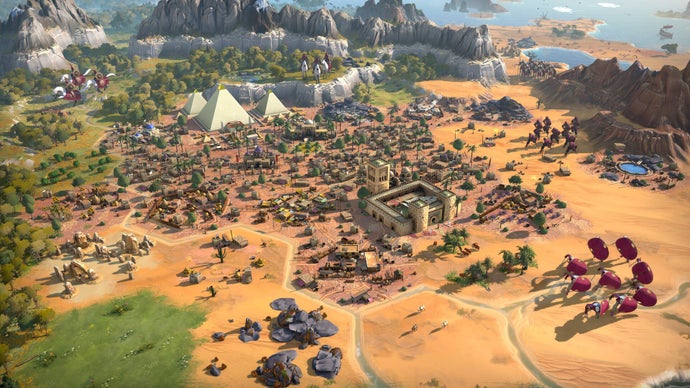
Amplitude Studios has officially announced Humankind 2, a full sequel to its 2021 turn-based 4X strategy game. The game arrives in 2027, giving the studio six years of development time to expand on the original's ambitious historical simulation framework.
Humankind carved out a distinctive niche in the crowded 4X strategy space by centering gameplay around cultural hybridization across historical eras. Rather than playing as a single nation tied to one heritage, players mixed and matched traits from different real-world civilizations. The Mayas' astronomical knowledge combined with Roman engineering created emergent historical narratives that felt both grounded and fantastical. The first game launched to solid critical reception, though it faced competition from established franchises like Civilization 6 and Total War Warhammer.
Humankind 2 inherits this core design philosophy while adding climate change as a dynamic system layer. This marks a significant thematic shift for the genre. Most 4X games treat environmental factors as minor mechanics or static map elements. Amplitude is integrating climate as an evolving threat that pressures player civilizations across multiple eras, forcing strategic adaptation in real time. Rising temperatures, resource scarcity, and ecosystem collapse create variable win conditions beyond traditional conquest or cultural victory.
The climate system carries real consequences for gameplay. Players cannot ignore environmental deterioration or dismiss it as late-game flavor text. Civilizations must balance territorial expansion, industrial development, and ecological preservation simultaneously. This mechanic echoes growing player interest in climate-focused game narratives, visible in titles like Terra Nil and Unpacking's eco-conscious design philosophy.
The 2027 release window suggests Amplitude takes this sequel seriously. Developing a functioning climate simulation integrated with 4X mechanics requires substantial technical work. The studio must model how climate changes ripple across trade routes, agriculture yields, population growth, and military logistics. Civilization 6, the franchise's reigning competitor, still lacks systemic climate mechanics nearly a decade after launch. If Amplitude executes this correctly, Humankind 2 could establish climate as a baseline expectation for modern strategy gaming.
Returning players will recognize the culture-mixing system, though the studio will likely expand available historical factions and era transitions. The first game rotated cultures through Ancient, Classical, Medieval, Renaissance, Industrial, Modern, and Contemporary periods. More civilizations means more combination potential and replayability, directly addressing player feedback about limited endgame variety.
The strategy genre faces fragmentation. Baldur's Gate 3 captured casual strategy players with narrative depth. Crusader Kings 3 dominates dynastic simulation. Total War Warhammer owns fantasy miniatures combat. Europa Universalis 4 keeps hardcore grand strategy grinders occupied. Humankind 2 must carve territory by delivering something those franchises avoid: a historically grounded, culturally hybrid experience that acknowledges modern ecological realities.
Amplitude published Endless Legend and Endless Space before Humankind, building credibility in systemic design. The studio understands how to layer complexity without sacrificing accessibility. If climate mechanics feel integrated rather than tacked on, Humankind 2 could reshape how the industry approaches environmental storytelling in games.
The 2027 arrival keeps development on track for next-generation console optimization. Current-gen hardware already struggles with dense 4X turns in late-game scenarios. Two additional years grants Amplitude breathing room for performance optimization across PC and console versions.