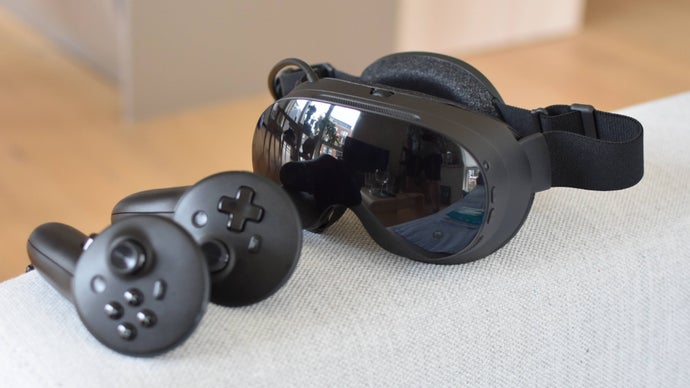
Valve's Steam Frame VR headset launched for pre-orders today, marking the company's entry into the competitive virtual reality hardware market. The wireless headset starts at £889 ($1,059 USD), positioning it as a premium option in the consumer VR space dominated by Meta's Quest 3S, HTC's Vive XR Elite, and Sony's PlayStation VR2.
The Steam Frame completes Valve's hardware triumvirate announced back in November 2025, alongside the refreshed Steam Machine and redesigned Steam Controller. This represents a major pivot for the company, which has historically avoided manufacturing consumer hardware beyond controllers and the Steam Deck handheld. The wireless connectivity removes a traditional tether, addressing a long-standing friction point for room-scale VR experiences.
Pricing positions the entry-level Steam Frame squarely against enthusiast-tier competitors rather than budget offerings. Meta's Quest 3S undercuts it significantly at $199-$399, though that device relies on smartphone-class processors. The Steam Frame targets PC gamers with high-end systems capable of leveraging SteamVR's ecosystem. Valve's decision to launch as a wireless-first device suggests confidence in both Wi-Fi 6 stability and the raw horsepower of gaming PCs to handle streaming VR content without latency issues that plagued earlier wireless solutions.
The review embargo lifting today gives publications and content creators the green light to publish detailed impressions. Early coverage will prove critical for Valve's credibility in a market where consumer skepticism runs high. VR adoption has plateaued in recent years, with industry analysts pointing to comfort concerns, limited killer apps, and high price points as persistent barriers. Valve's SteamVR platform already hosts thousands of titles, removing the library problem that plagued earlier hardware launches.
The Steam Frame announcement arrives during a transitional period for PC VR. The Meta Quest 3 shifted consumer expectations toward affordable standalone devices, while PC VR remained a niche pursuit for enthusiasts. Valve's entry signals belief that a high-end, PC-tethered experience still commands market demand, particularly among players already invested in SteamVR software libraries and high-end GPU hardware like Nvidia's RTX 40-series cards or AMD's equivalent offerings.
Manufacturing represents another challenge. Valve's Steam Deck supply chain demonstrated the company's capacity to manage hardware production at scale, but VR headsets involve optically precise components and demanding calibration processes. Any delays or quality control issues could damage Valve's reputation in an already skeptical market.
The pre-order launch also signals timing awareness. Winter holidays represent prime hardware purchasing season in Western markets, and Valve's November announcement provided sufficient runway for pre-order anticipation. Shipping logistics for a device at this price point will demand careful fulfillment planning to avoid the negative coverage that plagued previous VR launches facing delays.
Success ultimately hinges on software momentum. Valve's Half-Life Alyx demonstrated VR's potential for narrative experiences, but the studio has remained quiet on new first-party VR projects since that 2020 release. Third-party developers including Aperture Desk Job and numerous indie studios create the daily content driving headset utility, but Valve's own release schedule will define whether the Steam Frame attracts mainstream attention or remains positioned as a niche platform for existing VR enthusiasts.