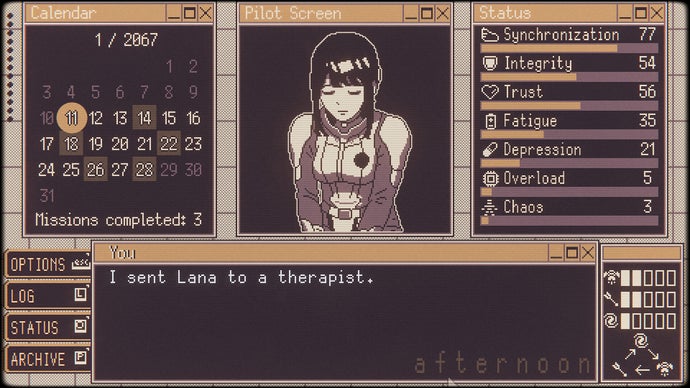
Valkyrie Iteration: Mecha Pilot Raising Pocket Simulator arrives as a sci-fi visual novel that blends the raising sim genre with mecha storytelling and psychological stakes. The game tasks players with nurturing a mech pilot while managing her mental health, drawing explicit parallels to the existential despair that defines Neon Genesis Evangelion.
The raising sim genre typically leans toward paternal or familial dynamics, but Valkyrie Iteration carves out different narrative territory. Instead of traditional parenting mechanics, the game centers on mentoring a pilot destined to operate giant robots in combat. Players make choices that shape the pilot's combat ability, psychological resilience, and relationships. The Evangelion comparison signals the game's willingness to explore darker emotional territory. The protagonist faces real trauma, isolation, and despair that developers refuse to gloss over with typical cheerful sim mechanics.
Visual novels remain a strong format for character-driven stories that lean on player choice and dialogue branches. Valkyrie Iteration uses this framework to create meaningful interactions between mentor and pilot. The "pocket simulator" subtitle suggests a streamlined experience designed for shorter play sessions rather than sprawling 40-hour epics. This accessibility positioning matters for a niche subgenre trying to attract players beyond hardcore visual novel enthusiasts.
The mecha angle gives the game mechanical and thematic weight. Piloting giant robots traditionally carries physical risk, but Valkyrie Iteration weaponizes psychological risk as well. A pilot who falls into depression performs worse in combat. A pilot who feels isolated makes reckless decisions. These systems tie narrative and gameplay together. They force players to genuinely care about the pilot's wellbeing because ignoring her mental state directly sabotages mission success.
This design philosophy breaks from raising sims that treat character stats as purely mechanical concerns. Instead, Valkyrie Iteration uses emotional storytelling to make stat management feel consequential. When a player sees their neglect reflected in a pilot's dialogue, in her desperation, in her willingness to take suicidal risks during combat, the mechanics stop feeling abstract.
The Evangelion reference carries specific weight. Hideaki Anno's mecha anime series refused to separate giant robot action from protagonist suffering. Shinji Ikari's depression shaped every battle. His trauma made fighting feel hopeless. His isolation made him dangerous. Valkyrie Iteration channels this sensibility. It promises a game where combat sequences intercut with scenes of a young woman breaking down, where victories feel hollow because the cost to the pilot remains visible and unavoidable.
Visual novel publishers have experimented extensively with raising sim mechanics as structural frames. Games like Hades and Fire Emblem: Three Houses proved that players embrace deep character relationships when mechanical progression depends on sustained attention. Valkyrie Iteration applies this lesson to the visual novel format, where narrative weight naturally compounds with player investment.
The game positions itself for PC players seeking narrative experiences that treat mental health seriously rather than as background flavor. It appeals to players who appreciate mecha storytelling but want human drama to drive the action rather than exist alongside it. By naming Evangelion directly, developers telegraph their ambitions. They signal willingness to hurt the player, to make moral choices sting, to refuse happy endings when the character's journey doesn't support them.
Valkyrie Iteration: Mecha Pilot Raising Pocket Simulator launches as a game that respects both raising sim mechanics and mecha narrative traditions while refusing sentimentality about either.