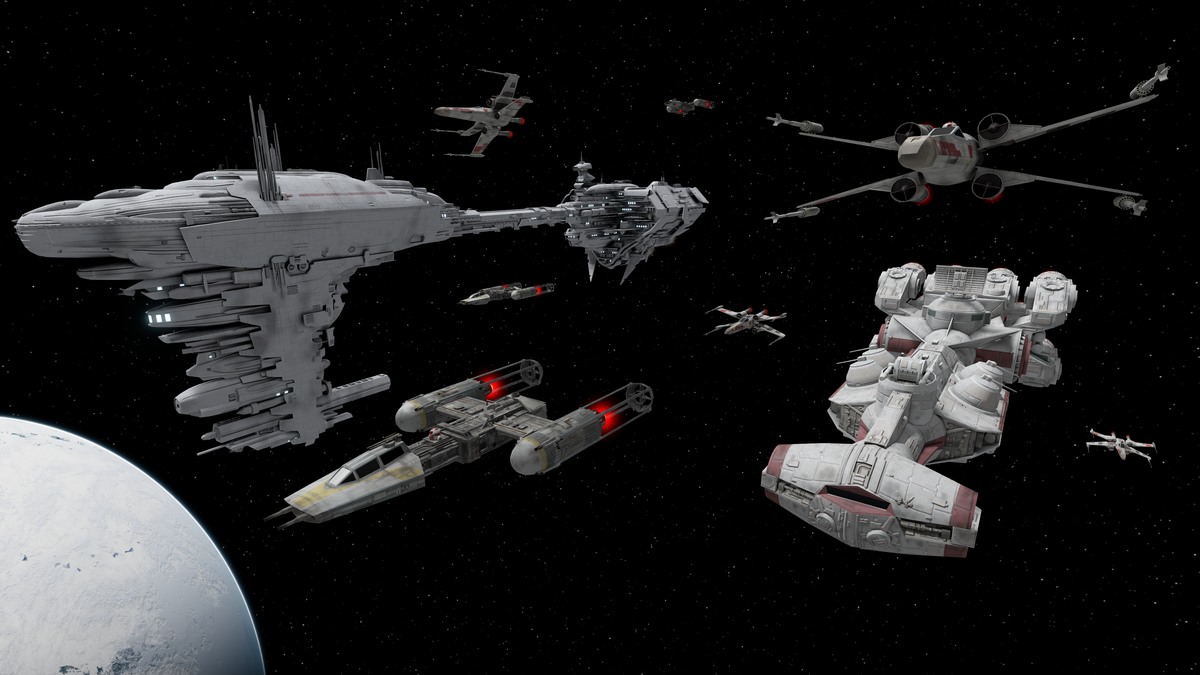
For nearly two decades, a dedicated team of volunteers has quietly built Fate of the Galaxy, a fully-featured Star Wars space combat simulator that runs on modest hardware and costs absolutely nothing. This total conversion mod for the open source FreeSpace 2 Open engine stands as a remarkable testament to what passionate fan communities can accomplish when corporate gatekeepers step aside. Available through the Knossos launcher with no need for the original FreeSpace 2, Fate of the Galaxy offers several mission-based campaigns, a roster spanning from X-Wings to Boba Fett's Firespray 31, and proof that you don't need a cutting-edge gaming PC to pilot starfighters—the game runs smoothly on an i5-1145G7 with integrated graphics.
The game's development journey tells a story of resilience. After weathering numerous team changes and shifts in focus, documented on the FreeSpace Wiki, Fate of the Galaxy has emerged as a proper nerdy sim with substance to match its scope. A bustling 3D cockpit, intricate keyboard shortcuts, energy management between fore and aft shields, individual subsystem targeting with ion cannons, pilot commands, and strategic gun synchronization decisions transform this from a casual shooter into something requiring genuine tactical consideration. The production's generosity extends beyond gameplay—there's a mission editor with text-based files for easier sharing, VR support with head-tracking, and an online manual accessible via Google Doc. All of this fits within approximately seven gigs of disc space.
What makes Fate of the Galaxy particularly noteworthy in 2026 is its transparent stance on generative AI, a topic of much concern in modding circles. The official site boasts that all visual assets were 'made by humans only,' though some artificial VO appears during tutorials using what sounds like antiquated robocaller software rather than modern chatbot technology. The FreeSpace Open engine itself predates the current AI invasion entirely—the original FreeSpace 2 launched in 1999, a more civilised age when everybody still thought Darth Vader was an arsehole.
The unofficial nature of Fate of the Galaxy is evident in its defiant opening crawl, which takes the official orchestral Star Wars theme and moves every note up or down a place, as though spitefully jolting the piano around under John Williams' fingers. It's a cheeky middle finger to corporate copyright enforcement, yet this fan project demands to be played seriously once you strap in.
Games like Fate of the Galaxy deserve recognition and protection. While LAN multiplayer performance might suffer on budget laptops, and a proper joystick would enhance the experience considerably, this is a complete, ambitious game built by humans for the love of Star Wars. In an era of corporate sequels and licensed mediocrity, that matters.