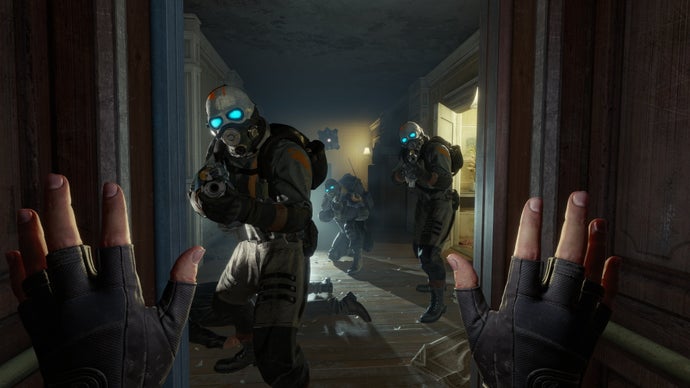
Valve weighed creating an original VR title for Steam Deck before ultimately pursuing a more ambitious goal: porting Half-Life: Alyx to run as a standalone experience without PC tethering. The decision reveals how the company prioritizes its existing flagship content over new projects when launching hardware.
The company's track record shows calculated bundling strategies. Aperture Desk Job launched alongside Steam Deck in 2022, establishing a template for hardware debuts. Half-Life: Alyx shipped with Valve Index in 2019, becoming the marquee VR title that justified the headset's premium pricing. Both moves created day-one value propositions for early adopters.
The Steam Deck situation presents a different puzzle. Valve could have greenlit a new VR game built ground-up for the portable device. Instead, executives chose to tackle what they internally labeled a "ludicrous" engineering challenge: getting Alyx running on standalone hardware without relying on PC compute power.
This choice signals Valve's assessment of player demand. Half-Life: Alyx remains the reference point for VR gaming three years after launch. The game shipped to critical acclaim, with its environmental storytelling and puzzle design setting a standard that competitors still chase. Porting it to standalone hardware extends its commercial runway and reaches audiences who lack high-end PC setups.
The technical hurdles explain Valve's characterization. Half-Life: Alyx uses Source 2 engine with sophisticated physics simulations, complex lighting calculations, and dense asset streaming across City 17's environments. Condensing that fidelity onto portable hardware requires aggressive optimization. Every system from GPU rendering to memory management demands reworking.
Valve has experience shipping demanding VR content efficiently. Halflife 2: Episode One proved feasible on Xbox 360, though it required substantial compromises. Alyx represents a more complex undertaking given its visual ambition and the performance delta between PC VR rigs and mobile chipsets.
The standalone pivot also addresses market realities. Quest 2 and Quest 3 dominate consumer VR adoption, with over 15 million units sold combined. PC VR remains a niche category despite Index's quality. By bringing Alyx to standalone platforms, Valve taps into the installed base that currently lacks access to its killer app.
Previous attempts at PC-to-VR ports illustrate the complexity. Porting games down rarely produces satisfying results without substantial redesign. Half-Life: Alyx's original design assumed PC-grade performance budgets that mobile platforms cannot support. Valve's team likely spent months stress-testing architecture and identifying which features could survive compression.
The decision to pursue this instead of greenlighting new VR content reflects confidence in Alyx's staying power. Rather than split resources between maintenance and creation, leadership bet that delivering the existing masterpiece to new audiences generates more value than launching something unproven.
This pragmatism defines modern Valve. The studio funds fewer original projects than competitors but maximizes returns on proven properties. Steam Deck received Aperture Desk Job, a charming intro experience, not a tentpole title. Alyx gets the prestige treatment because it already justified its own existence.
The outcome remains uncertain. Whether the standalone version ships on Quest platforms depends on negotiations between Valve and Meta, competitive agreements, and technical viability at launch. But the internal calculus already resolved: Alyx matters more than speculation about what might have been.