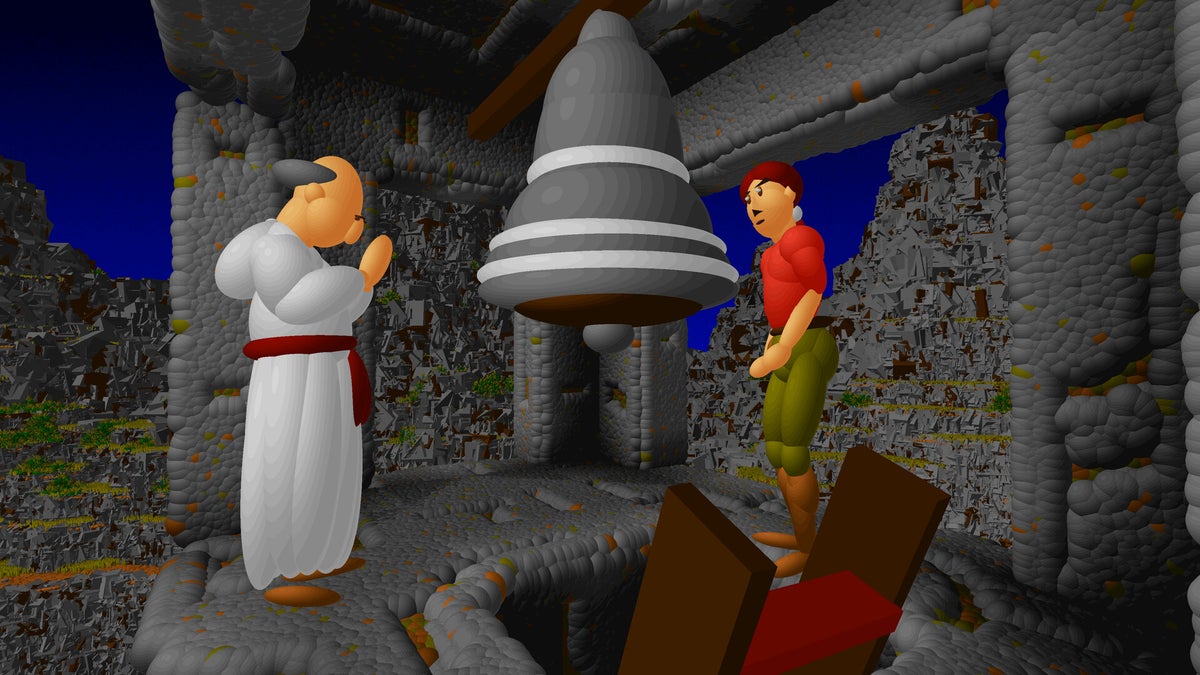
Ecstatica, a 1994 horror game built on a radical visual engine that rejected polygonal 3D altogether, returns to PC today with a fresh release that resurrects one of gaming's strangest technological experiments. The title's distinctive "ellipsoid" graphics system created a world of bulbous, organic shapes that look nothing like the angular polygon-based aesthetics that eventually dominated the industry for three decades.
Developed in an era when 3D graphics were still contested territory, Ecstatica pursued an entirely different path than competitors. Rather than modeling objects with vertices and polygons, the engine constructed everything from overlapping ellipsoids, spheres, and blob-like forms. This approach produced environments that appear almost nauseating in their warped curvature, yet remain oddly compelling. Characters twist and deform in ways that early polygonal games simply could not achieve. The visual language feels completely foreign to anyone raised on standard 3D graphics.
The 32-year vintage matters less than what Ecstatica represents. It exists as proof that the polygon-dominant timeline was not inevitable. Three-dimensional rendering could have taken numerous paths. Procedural generation, voxel systems, implicit surface rendering, sprite-based trickery, and yes, ellipsoid-based geometry all competed for dominance in the early 1990s. GPU manufacturers and software vendors ultimately settled on rasterization and polygon pipelines because they proved faster, cheaper, and easier to license at scale. Market consolidation locked in DirectX and OpenGL. Unreal Engine and Unity became synonymous with 3D development. Alternative approaches withered.
Ecstatica ran on minimal hardware by today's standards. A 386 PC could run it. No specialized graphics card was required, which made it accessible relative to competing 3D solutions of the period. The horror theme created a perfect fit for the unsettling aesthetic. The game's eerie, distorted world naturally synergized with its peculiar rendering approach rather than fighting against it.
Today's re-release carries historical weight beyond nostalgia. The gaming industry now operates under extreme technological centralization. A handful of engine providers, GPU companies, and cloud platforms control the infrastructure. Revisiting old alternatives reminds developers that current solutions emerged from contingent choices, not inevitable physics. Different trade-offs were possible then. They remain possible now.
The re-release also serves practical purposes. Emulation communities keep older games alive, but official ports with modern compatibility layers matter for accessibility and preservation. Getting Ecstatica running on current Windows systems without DOS emulation or virtualization layers makes the game genuinely playable for audiences born decades after its original launch.
Whether anyone beyond curiosity-seekers and historians bothers playing Ecstatica today remains uncertain. The game itself existed in 1994's crowded survival horror marketplace, overshadowed by Resident Evil's debut that same year. But the 2026 re-release isn't marketed as a hidden masterpiece waiting for rediscovery. It functions as a museum piece, a document of path not taken. In an industry dominated by three-engine hegemony and algorithmic procedural generation, glimpsing a genuinely alien approach to 3D space carries value independent of entertainment merit.