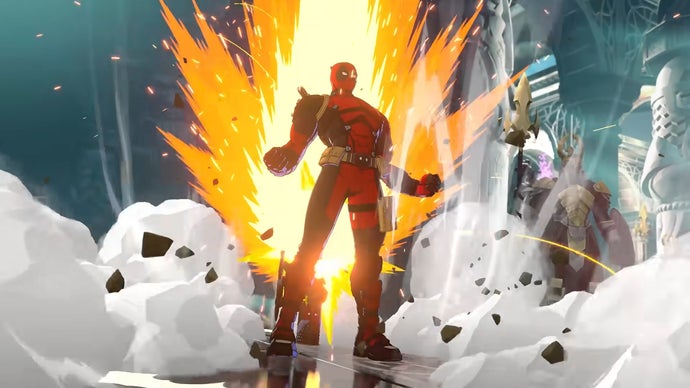
# Marvel Tōkon's Deadpool Abandons Joke Character Status for Fighting Game Legitimacy
Deadpool arrives as a playable fighter in Marvel Tōkon, and the game takes the merc with a mouth seriously in ways his previous interactive appearances never did. The character trades his usual fourth-wall-breaking comedy routine for genuine fighting game mechanics and character depth that respects the genre's traditions.
Wade Wilson has always occupied an odd space in Marvel's roster. His healing factor mirrors Wolverine's, but where Logan stays brooding and serious, Deadpool weaponizes meta-awareness. He knows he exists in comic panels, film frames, and game windows. He riffs on that knowledge constantly, treating narrative convention as another target for his katanas. This tendency has defined his character across media since Rob Liefeld and Fabian Nicieza introduced him in New Mutants #98.
The difference in Marvel Tōkon comes down to creative intent. Previous Deadpool games leaned hard into irreverence and fourth-wall demolition as their core appeal. Marvel Tōkon instead prioritizes fight mechanics over punchlines. The game presents Deadpool as a legitimate combatant with a coherent moveset, damage scaling, and frame data that matters. His animation work matches the precision and weight expected from modern fighting games.
This shift reflects broader industry maturity around fighting game design. Marvel vs. Capcom 2 and Ultimate Marvel vs. Capcom 3 succeeded partly through character variety and personality, but modern titles like Street Fighter 6 and Tekken 8 balance character uniqueness with mechanical integrity. You can have a memorable character without sacrificing competitive viability or clear hitboxes.
Deadpool's presence in Marvel Tōkon signals respect for both the character and the fighting game community. Rather than relying on "he's crazy so anything goes," the developers built a fighter with recognizable attack patterns, recovery windows, and strategic depth. His personality comes through his animations, voice work, and aesthetic choices, not through constant dialogue breaks that undermine match flow.
The meta-awareness that defines Deadpool in comics and film actually becomes a liability in a fighting game context. Breaking character between rounds, acknowledging the player's controls, or commenting on the arcade cabinet would disrupt the competitive rhythm that modern fighting games demand. Marvel Tōkon respects that boundary. Deadpool still feels like Deadpool through his visual style and attitude, but he functions as a proper fighting game character first.
This creative decision matters beyond Deadpool. It demonstrates that licensed fighting game rosters can feature distinctive, personality-driven characters without sacrificing mechanical depth or competitive integrity. Studios no longer need to choose between character flavor and gameplay substance. The best modern fighters prove you can have both.
Marvel Tōkon's approach to Deadpool joins a broader trend toward treating fighting games as legitimate competitive spaces where character design serves gameplay rather than undermining it. The game takes its roster seriously. That respect extends upward to the players, the competitive community, and the genre itself. Deadpool works best when treated as a proper fighter first and a joke character second.