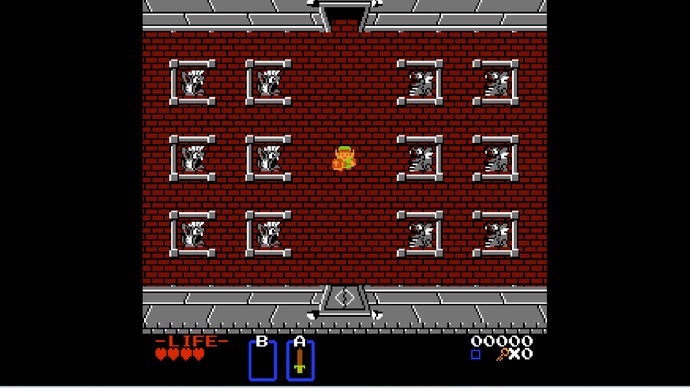
A new free browser game called The Tower of Zeldaga flips the script on Nintendo's legendary Zelda franchise by casting players as rescuers of Ganondorf instead of his captors. The game mashes up mechanics from The Legend of Zelda with Namco's 1984 arcade classic The Tower of Druaga, creating a retro-styled dungeon crawler that inverts traditional franchise roles.
In The Tower of Zeldaga, the premise inverts expectations. Players don't battle to save Princess Zelda or stop the Dark Lord's schemes. Instead, they navigate towers to rescue Ganondorf from an unnamed evil blonde queen who has imprisoned him. The game embraces this role reversal with deliberate humor, playing on decades of Zelda lore while paying homage to Druaga's top-down dungeon design.
The mashup approach represents a growing trend in fan-made games that deconstruct beloved properties through creative reinterpretation. The Tower of Zeldaga strips both franchises to their mechanical essences. Druaga's puzzle-heavy vertical climbing combines with Zelda's item collection and exploration loops. Players move through screen-by-screen rooms, solve environmental puzzles, collect keys, and fight enemies using weapons and tools scattered throughout the dungeon. The visual style mimics 8-bit and 16-bit aesthetics from the original Zelda games and arcade machines, creating immediate nostalgia for players who grew up with these titles.
The game's existence arrives amid broader conversation about Nintendo's approach to its classic properties. Recent announcements of the Ocarina of Time remake sparked debate within the gaming community about art direction and character design choices. The Tower of Zeldaga offers an alternative perspective. It celebrates retro gaming without demanding modern reconstruction. By working within established pixel-art conventions, the developers sidestep questions about reinterpretation and fidelity. They simply honor the source material's spirit while creating something entirely new.
The free distribution model matters here too. The Tower of Zeldaga avoids copyright complications by existing in gray legal territory. Nintendo traditionally guards its intellectual property zealously, issuing cease-and-desist orders against fan projects. However, non-commercial fan games sometimes persist longer, particularly those distributed through itch.io or similar platforms. The Tower of Zeldaga's availability as a free browser game makes it highly accessible. Players need no downloads, no installations, no console purchases. They click and play immediately.
This kind of creative remix speaks to player desire for experimentation within established franchises. The gaming community has grown sophisticated about intellectual property. Fans understand that companies like Nintendo must protect trademarks. Yet they also recognize that fan creators fill legitimate demand for alternative takes on beloved properties. The Tower of Zeldaga scratches that itch by asking simple questions: What if the villain was the hero? What if we combined two different games? What did dungeon crawling feel like in 1984 versus 1986?
The game arrives during a period when retro aesthetics dominate indie development. Hollow Knight, Celeste, Hades, and countless others prove that pixel-based visuals resonate with modern players. The Tower of Zeldaga taps into this nostalgia while adding the comedic layer of premise inversion. It's technically a parody, mechanically a homage, and aesthetically a love letter to gaming's 8-bit era. For players fatigued by debates over modern remakes, The Tower of Zeldaga offers something simpler. It just lets you play.