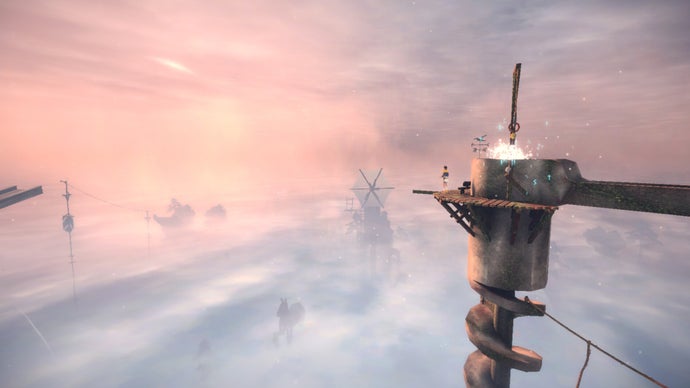
TALON TOWERS taps into the artistic sensibility that defined Fumito Ueda's most celebrated work. This parkour platformer channels the Japanese auteur's signature aesthetic: towering structures suspended above an endless fog, minimalist design language, and a focus on verticality as both challenge and atmosphere.
The game places players on massive, crumbling monuments that rise from an impenetrable mist. Movement is the core mechanic. Players vault, leap, and traverse these deteriorating platforms while the drop below guarantees failure. There's no combat, no dialogue wheel, no systems layer obscuring the core experience. Just navigation, timing, and the constant threat of falling into nothing.
Fumito Ueda directed only three major titles in his career: ICO (2001), Shadow of the Colossus (2005), and The Last Guardian (2016). Each redefined what players expected from game design, favoring atmosphere and emotional resonance over mechanical complexity. His sparse approach to storytelling, combined with environmental scale that dwarfs the protagonist, became his signature. TALON TOWERS borrows heavily from this playbook. The fog acts as ICO's environmental narrative device. The scale recalls Shadow of the Colossus. The platforming draws from The Last Guardian's traversal systems, where movement itself becomes puzzle-solving.
What separates TALON TOWERS from Ueda homage is its commitment to parkour as a complete system. Modern parkour platformers like Celeste and Grapple Force Rioter have proven the genre's depth when tuned correctly. TALON TOWERS appears to take that lineage seriously, building momentum-based movement mechanics that demand precision while rewarding flow state gameplay.
The fog is not mere aesthetic window dressing. It creates psychological pressure. Traditional platformers offer visible ground below, allowing players to judge depth and distance. Here, the void is absolute. Every jump requires faith. Every landing must be precise. This transforms the experience from pure skill test into something more meditative and tense simultaneously. The designer forces constant attention, never allowing comfort.
The setting matters too. Talon Towers are crumbling monuments, not pristine playgrounds. They suggest history, decay, purposefulness now lost. This world-building works on the player unconsciously. Why do these structures exist? Why are they falling apart? What lies in the fog? Ueda never answered such questions directly in his games either. He left players to construct their own narrative through observation and movement through space.
This approach has limited commercial appeal. Ueda's games sold well by premium standards but never approached mainstream blockbuster numbers. ICO moved under two million copies despite critical unanimity. Shadow of the Colossus performed better, reaching five million, but The Last Guardian struggled commercially despite its artistic achievement. Publishers hesitate to fund games that prioritize atmosphere and walking over action loops.
TALON TOWERS likely targets a specific audience: players who recognize the Ueda DNA, who value artistic coherence over feature sprawl, and who see parkour mechanics as an extension of sculptural game design rather than a competitive skill ladder. It's a bet that enough players still hunger for that approach.
The platformer market remains robust. Indie developers continue releasing strong entries that find niches within the broader genre. If TALON TOWERS executes its core loop cleanly, delivers compelling level design that respects player skill expression, and maintains consistent atmosphere throughout, it will find its audience. That audience may be smaller than mainstream releases demand, but it will be devoted.