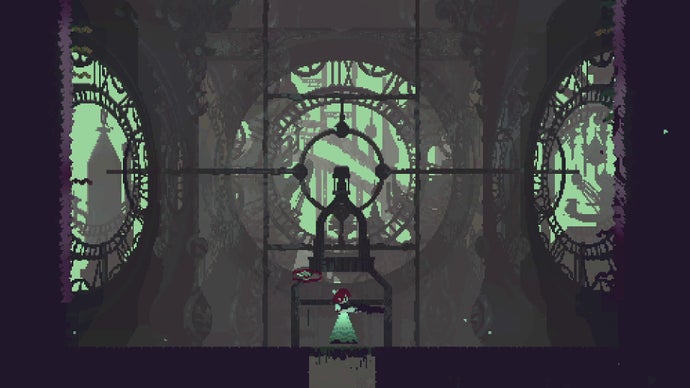
Iron Bramble arrives as the spiritual successor to Rusted Moss, the grappling hook metroidvania that carved out a devoted following. Developer Thot Pixel returns with another pixel art adventure, this time swapping lush environments for a cyber-gothic megastructure dripping with industrial dread.
The core mechanic remains unchanged. A grappling hook lets players swing through sprawling interconnected levels at breakneck speeds, defining the platforming rhythm that made Rusted Moss stand out. The skill ceiling runs high. Precision timing and spatial awareness separate casuals from speedrunners, and Iron Bramble doesn't hold hands. Its difficulty sits comfortably in that sweet spot between punishing and fair, the kind of game that respects player competence without becoming gatekeeping.
The narrative twist sets Iron Bramble apart from its predecessor. You play as a story-eating demon woman navigating a world where humanity abandoned flesh entirely. Human consciousness now inhabits mechanical bodies, metal husks stripped of organic form. This premise delivers genuine worldbuilding weight. The cyber-gothic aesthetic amplifies the existential dread. Towering structures dominate the skyline. Rusted machinery creaks under its own weight. The color palette leans toward grays, blacks, and sickly neon accents. Every environment communicates that something went deeply wrong.
Metroidvania games live and die by exploration and progression gating. Iron Bramble's megastructure world offers vertical and horizontal pathways, locked areas begging for ability upgrades, and the kind of environmental storytelling that rewards backtracking. Players discover new techniques, unlock shortcuts, and gradually piece together the world's haunting history. The grappling hook serves double duty. It powers through combat encounters and navigates environmental hazards, maintaining mechanical cohesion between traversal and challenge.
Thot Pixel's pixel art style punches above its technical constraints. Every frame conveys movement, impact, and atmosphere. The animation work shines during grappling sequences, where momentum transfers through visual feedback. Enemy design reflects the setting. You won't fight fantasy creatures here. Instead, corrupted robotic entities and amalgamations of flesh and metal populate the megastructure, visual representations of the world's fallen state.
The difficulty curve matters here. New players will struggle. The grappling hook demands muscle memory, timing precision, and spatial reasoning that doesn't develop overnight. Checkpoints exist, but Iron Bramble doesn't grant them out of pity. You'll repeat sections. You'll fail boss fights. That friction builds satisfaction when patterns click into place. Speedrunners will find routes optimized for flow. Casual players need patience.
Iron Bramble taps into a proven formula while creating its own identity. It doesn't reinvent the metroidvania blueprint. Instead, it recognizes what worked in Rusted Moss and scales up ambition. The cyber-gothic megastructure world promises environmental variety and narrative depth beyond what most grappling hook platformers deliver. The story-eating demon protagonist signals that this entry embraces its strange premise fully rather than sanding it down for mass appeal.
This is a game built for players who finished Rusted Moss hungry for more, who mastered Hollow Knight's movement, who see difficult platformers as puzzles waiting to be solved. Iron Bramble won't convert skeptics of the genre, but it validates everyone already convinced that grappling hook metroidvanias represent gaming's most underrated corner of 2D design.