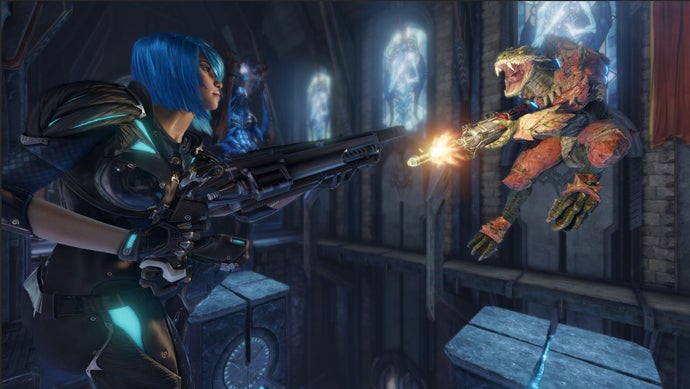
Quake Champions abandons its free-to-play model after nearly a decade, converting to a premium £9 purchase on Steam. The shift eliminates battle passes, loot boxes, premium currencies, and the entire in-game store. Players who participated in free Steam events receive automatic upgrades to the full version. Anyone who spent money on premium currency within the last two months gets refunded.
The decision follows recent layoffs at id Software, the game's developer. Those cuts reshaped the studio's priorities and forced a reckoning with Quake Champions' monetization structure. The free-to-play approach, which launched alongside the game's 2017 early access debut, failed to generate sustainable revenue. The model frustrated players with aggressive monetization and fragmented the playerbase across free and paid tiers.
Quake Champions entered early access in 2017 as a free-to-play arena shooter built on id Tech's engine. It targeted competitive players nostalgic for classic Quake deathmatch gameplay while competing against free competitors like Quake Live and paid rivals like Valorant. The freemium structure never gained the traction id hoped for. Player counts remained modest compared to established esports titles. Seasonal battle passes and cosmetic loot boxes generated revenue insufficient to justify continued development at the scale id maintained.
The pivot to premium pricing represents a fundamental reset. Id acknowledged that the free-to-play monetization system created friction rather than engagement. The store removal eliminates ongoing temptation to spend, shifting the value proposition entirely. Players now buy once and access the full roster of champions, weapons, and maps without progression walls or seasonal gating.
This decision carries broader implications for the arena shooter genre. Games like Valorant and Counter-Strike 2 prove competitive shooters sustain themselves through cosmetic monetization at free-to-play price points. Quake Champions never achieved that scale. The premium conversion suggests id prioritizes player experience over extraction-based revenue models. It also reflects the financial constraints facing mid-tier studios post-layoff. Smaller teams cannot support extensive live-service infrastructure.
The refund policy for recent spenders demonstrates good faith amid the conversion. Steam's recent purchase protection guarantees players won't absorb losses. This contrasts sharply with games that introduce monetization changes without compensation.
Quake Champions now competes directly against Quake Live, which remains free-to-play on Steam. The premium tier differentiates Champions through faster matchmaking, dedicated servers, and cleaner progression systems. Players choosing between the two face a straightforward decision: free access with community servers or paid entry with official infrastructure.
The move also signals id's commitment to Quake as a franchise. Rather than abandoning Champions entirely post-layoff, the studio streamlined it for sustainability. Smaller development teams can maintain a premium title more easily than a free-to-play game requiring constant seasonal content. This approach lets id preserve Quake Champions' competitive foundation while reducing ongoing operational costs.
The premium conversion launches immediately on Steam, with legacy free-to-play access ending. Existing players retain their progression and cosmetics in the new version. This represents one of few instances where a major free-to-play game successfully transitioned to premium pricing without killing the community or player progression.