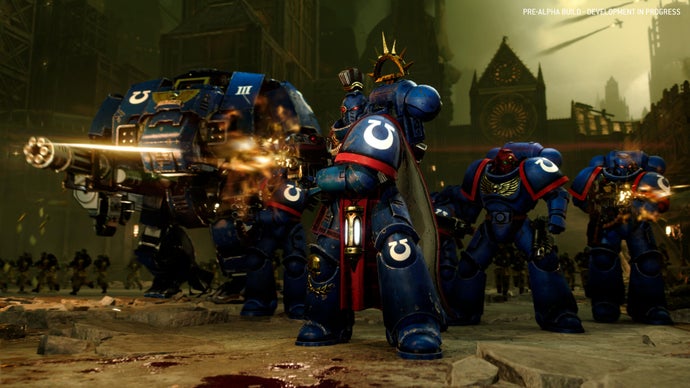
Creative Assembly's upcoming Total War: Warhammer 40,000 requires patient decision-making that conference demo sessions simply cannot deliver, as one journalist discovered firsthand during a hands-on session that ended with an Ork horde steamrolling their unprepared army.
Grand strategy games demand time. Players need breathing room to scout enemy positions, plan unit deployments, manage resources across multiple fronts, and execute layered tactical decisions without external pressure. Total War: Warhammer 40,000 fits this mold perfectly, but demo conditions work against everything the genre represents. Forty-thousand's real-time battles paired with turn-based strategic layer demand deliberation.
The journalist's loss to the Ork assault wasn't random bad luck. It stemmed from rushed positioning and inadequate preparation. That's the game working exactly as intended. Total War: Warhammer 40,000 punishes sloppy unit placement and hasty decisions. When you fail to anchor your lines properly, concentrate firepower on priority targets, or account for enemy flanking maneuvers, organized foes like Ork hordes will exploit those weaknesses. The game's complexity shines through in these failures. You learn more from a decisive defeat caused by poor tactics than from a scripted victory against weakened opponents.
This creates a core design challenge for how Creative Assembly presents Total War: Warhammer 40,000 at trade shows and conferences. Publishers want flashy spectacle. Twelve-minute demo windows favor immediate gratification and visible action. Total War: Warhammer 40,000 offers neither during its setup phase. The turn-based map layer requires patient planning. Even the real-time battles reward cautious positioning over frantic unit spam. A conference attendee dropped into active combat with no context cannot appreciate how terrain, unit composition, and tactical awareness determine outcomes.
The Warhammer 40,000 license adds another layer. Games Workshop's universe spans 10,000 years of grimdark warfare with dozens of factions, each playing fundamentally differently. Orks rely on aggressive momentum and melee superiority. Eldar favor mobility and precision strikes. The Astra Militarum emphasizes massed firepower and holding ground. Demo players encountering faction mechanics for the first time while managing real-time combat decisions face an impossible learning curve.
Rock Paper Shotgun's hands-on revealed something valuable though. Total War: Warhammer 40,000 clearly delivers on its strategic depth promise. The journal's author recognized exactly why they lost and what they needed to do differently. That self-awareness signals strong game design. Players understand cause and effect. Defeat feels earned, not random.
Creative Assembly has two previous Total War: Warhammer entries to draw from. Those games proved that Warhammer settings translate well into the Total War formula. The 40K version takes that foundation and applies it to a sci-fi military setting with established factions, units, and lore that Games Workshop has refined across decades.
For PC strategy enthusiasts, Total War: Warhammer 40,000 represents another substantial entry into a thriving genre. It releases into a market that still plays Dawn of War III, Gladius Relics of War, and the original Battlesector. Each scratches different strategy itches. Total War: Warhammer 40,000 offers grand-scale campaigns with deep unit variety and faction asymmetry.
Conference demos rarely capture strategy games properly. They highlight action sequences and visual spectacle instead of decision-making depth. Total War: Warhammer 40,000 demands proper context, preparation time, and player agency to shine. Judge it by its own standards, not demo conditions.