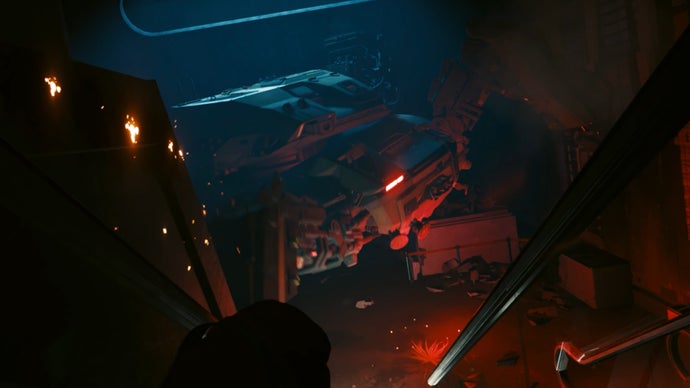
CD Projekt Red spent two years iterating on the Chimera tank boss fight in Cyberpunk 2077: Phantom Liberty, according to developer statements. The encounter represents one of the expansion's most technically demanding and visually elaborate set pieces, featuring a Ghost in the Shell-inspired armored vehicle that pursues the player through an extended action sequence before settling into a stationary combat phase.
The complexity behind this single boss encounter reveals the production challenges developers face when building large-scale, cinematic moments within open-world games. The Chimera fight demands coordination across multiple systems: AI pathfinding, environmental destruction, camera work during high-speed sequences, player feedback timing, and difficulty balancing across different difficulty settings. Each iteration required testing how players approached the fight, where difficulty spikes occurred, and how to maintain tension without frustration.
CD Projekt Red's two-year development cycle for this one encounter underscores why AAA game development costs have escalated dramatically. A boss fight that lasts perhaps ten to fifteen minutes on screen represents months of concepting, blocking, programming, animation, visual effects work, and playtesting. The studio needed to ensure the tank felt threatening, that its movement patterns telegraphed attacks clearly enough for players to react, and that the spectacle never overwhelmed player agency.
Phantom Liberty launched in September 2023 as a paid expansion to Cyberpunk 2077, which itself endured a notorious launch in December 2020 marked by severe technical issues on console platforms. The expansion marked CD Projekt Red's attempt to restore faith in the property through polished, ambitious content. The Chimera encounter epitomizes this approach: it's visually striking, mechanically sound, and serves as a climactic moment within the expansion's spy-thriller narrative.
The boss fight occurs late in Phantom Liberty's campaign, after players have equipped themselves with advanced cyberware and combat skills. The encounter tests these systems in ways that smaller skirmishes do not. The tank's size and firepower create environmental hazards that inform player positioning and movement decisions. This layered design philosophy explains why iteration took so long. Early playtests likely revealed that the fight felt either trivial or brutally punishing depending on player builds and approach angles.
Video game boss design occupies a unique space in game development. Unlike narrative sequences that play out linearly, or open-world exploration that rewards player choice, boss fights require precision tuning. They need to challenge experienced players while remaining beatable for those struggling with difficulty. They serve as skill checks that validate the time players invested in character progression.
The Chimera demonstrates how modern AAA production operates at the intersection of technical systems, visual ambition, and game design. Two years spent on a single encounter would have been unthinkable in earlier console generations, yet modern player expectations for production values and polish demand this investment. Whether those two years translate to player satisfaction remains subjective, but the fight's reputation among Phantom Liberty players suggests CD Projekt Red achieved its goal: a boss encounter that feels like a climactic moment worth the development effort spent building it.