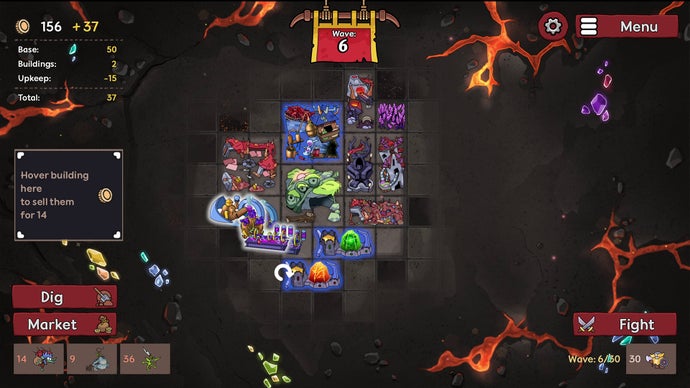
Packed Lair launches today as a genuinely fresh take on base building, blending Tetris-style spatial puzzles with roguelike progression and auto-battling mechanics. The game tasks players with playing as an evil lord who must construct an entire functional empire inside a severely constrained lair space, forcing ruthless optimization at every turn.
The core loop revolves around placing buildings and structures using Tetris-like block mechanics. Every placement matters because space is finite. You cannot simply build more rooms or expand freely. Instead, you arrange barracks, laboratories, treasuries, and other functional buildings within your tiny evil footprint, each taking up specific shapes and sizes on a grid. The tighter your layout, the more you can cram in before hitting the spatial ceiling. This constraint forces genuine decision-making about infrastructure priorities.
Your cramped lair directly impacts your army's strength and capabilities during auto-battles. Buildings generate resources, train troops, unlock spells, and provide passive bonuses. The better you organize your limited space, the stronger your conquering force becomes. This creates a feedback loop where base optimization directly translates to military success. You cannot simply brute force your way through combat by overwhelming numbers. Strategic building placement becomes your primary lever for power.
The roguelike structure means each run presents new constraints and opportunities. Lair layouts differ. Available buildings shift between runs. Resource generation varies. You must adapt your optimization strategy to each run's specific circumstances rather than following a single perfect blueprint. This prevents the game from becoming a solved puzzle and keeps each playthrough distinct.
Packed Lair occupies an interesting market space. Base-building games typically reward expansion and growth. Tetris-style games demand precision and foresight. Auto-battlers emphasize team composition and stat optimization. Packed Lair merges these three systems into one cohesive experience where spatial arrangement itself becomes the primary strategic tool. This hybrid approach should appeal to players fatigued by traditional empire builders who feel they lack meaningful constraints.
The evil lord theme provides personality without demanding narrative depth. You are not saving the world or defending your kingdom. You are conquering it. You are the villain. This perspective shift, combined with the comedic premise of squeezing an entire military-industrial complex into a dungeon closet, gives Packed Lair a distinct character. It leans into absurdist humor about space constraints rather than taking itself seriously.
The game launches on PC and appears designed for shorter runs rather than sprawling 40-hour campaigns. Each roguelike attempt should complete in a reasonable timeframe, making it accessible for players who prefer bite-sized gaming sessions. The daily release cadence suggests the studio expects players to return repeatedly rather than complete it once and move on.
Packed Lair represents the kind of genre experimentation that keeps indie gaming fresh. Rather than iterating on established formulas, it combines proven mechanics in unexpected ways and creates something that feels genuinely new. The spatial puzzle element transforms base building from spreadsheet optimization into tangible, tactile problem-solving.