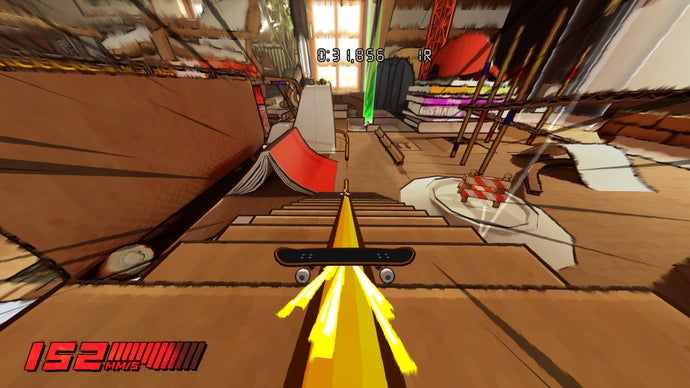
Stuntboost launches today as a skateboarding platformer that channels the fingerboard culture of Tech Deck toys into digital form. Developer Simteraction Studios built the game around performing tricks on cardboard constructs inside a bedroom environment, translating the tactile finger-skateboarding experience into a video game format.
The game positions itself as wish fulfillment for players who never mastered actual skateboarding or fingerboard tricks. Instead of requiring real-world coordination or risking scraped knees, Stuntboost lets players execute elaborate flip combinations and stunts in a safe, virtual sandbox. The bedroom setting grounds the action in a nostalgic, intimate space where imagination becomes gameplay.
Stuntboost operates as a tech demo disguised as a game. The focus remains narrowly on trick execution and momentum management rather than sprawling open worlds or complex narrative beats. This design choice keeps the scope manageable while emphasizing pure mechanica fluency. Players master control inputs to chain together flips, grinds, and aerial combinations across increasingly elaborate cardboard obstacle courses.
The cardboard construction aesthetic serves both practical and thematic purposes. Practically, it simplifies the visual framework and allows for rapid level design iteration. Thematically, cardboard evokes DIY culture and childhood creativity. Players aren't performing stunts in professional skate parks or corporate sponsored locations. They're doing it in a bedroom, using materials anyone can find in a garage or alley. This democratizes the skateboarding fantasy.
Tech Deck fingerboards experienced a resurgence in recent years, particularly among Gen Z audiences discovering retro toy culture online. Stuntboost taps into this renewed interest while offering something those physical toys never could: perfect physics, infinite attempts, and no broken fingers. The game removes failure's sting entirely. Crash your fingerboard? Instant restart. Botch a landing? Try again immediately.
The indie platformer space has embraced increasingly specific mechanics and aesthetic hooks. Stuntboost follows this pattern, targeting a niche audience that grew up with fingerboards and seeks that tactile satisfaction without the physical limitations. Games like Skate and its recent reboot proved skateboarding mechanics could carry entire titles. Stuntboost narrows that further, focusing on the fingerboard subset and the intimate, bedroom-based play space.
Performance and level design will determine whether Stuntboost justifies its existence beyond novelty appeal. The game must walk a fine line between accessibility and depth. New players need immediate gratification from performing cool tricks. Veteran players need progression systems and increasingly complex challenges to maintain engagement. Too simple, and players exhaust content in an afternoon. Too demanding, and the appeal dissolves into frustration.
PC platforms likely represent Stuntboost's launch target, though mobile versions could follow naturally. Fingerboard culture thrives on social media through trick videos and community sharing. Stuntboost's digital tricks could feed this ecosystem through built-in replay and sharing features, extending the game's lifespan beyond individual playtime.
The game arrives at a moment when indie developers continue fracturing gaming into ever-smaller, more specific experiences. Stuntboost doesn't attempt broad appeal. It exists for a particular audience seeking a particular feeling. Whether that audience proves large enough to sustain the project remains the genuine question.