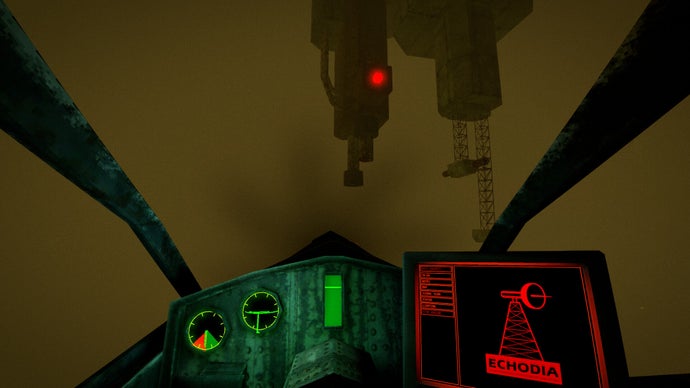
Developer Rubeki returns to its megastructure universe with The Hollowing, a spiritual successor to 2024's acclaimed Lorn's Lure that trades climbing axes for aircraft. Where Lorn's Lure demanded precision platforming and punishment tolerance, The Hollowing pivots toward exploration via flight mechanics, letting players navigate a murky megastructure by hopping between radio outposts.
Lorn's Lure established Rubeki's vision of verticality and environmental storytelling within massive artificial structures. The game earned respect from simulation enthusiasts and exploration fans, but its steep difficulty curve and relentless fall-death loop created friction for players seeking less punishing experiences. The repeated climbing sequences and precision demands became a barrier to entry for those interested in atmosphere and discovery over mechanical mastery.
The Hollowing addresses this directly. By introducing airplane-based navigation, Rubeki removes the instant-failure consequences of platforming errors while maintaining the core appeal of spelunking through incomprehensible structures. Radio outposts serve as waypoints and landing zones, giving players agency over their route through the facility. This design choice fundamentally lowers the skill floor without sacrificing the sense of exploration or scale that made Lorn's Lure compelling.
The shift reflects broader industry patterns around accessibility and player comfort. Studios increasingly recognize that difficulty and accessibility exist on separate axes. A game can challenge players intellectually and thematically without punishing them for mechanical imprecision. Flight-based exploration games like Outer Wilds proved audiences hunger for discovery-focused experiences that reward curiosity over reflexes. The Hollowing likely targets that same appetite.
Setting both games in the same narrative universe allows Rubeki to deepen worldbuilding without repetition. Players seeking more context about the megastructure's origins and purpose can jump between titles. This universe-building strategy works particularly well for indie developers who can't sustain franchise volumes like AAA publishers. Shared settings create replay value and reward series engagement.
The visual presentation matters here. Rubeki's handsome climbing axes in Lorn's Lure became iconic shorthand for the game's craft. The Hollowing's murky aesthetic suggests similar attention to detail, likely emphasizing atmosphere through visual design rather than clarity. Murk creates unease and mystery. Flying through darkness toward distant radio beacons evokes sci-fi horror games like System Shock or Event Horizon, suggesting The Hollowing leans into dread alongside exploration.
PC remains the likely lead platform given Rock Paper Shotgun's coverage focus and Lorn's Lure's positioning within the simulation and indie PC spaces. Console ports for Switch or PlayStation may follow, though flight-based exploration typically translates cleanly across platforms.
The Hollowing enters a healthy market for first-person explorers and simulation experiences. Games like Outer Wilds, Subnautica, and A Space for the Unbound demonstrated sustained interest in guided discovery without combat. The indie space particularly values these experiences, where tight narrative and focused scope outweigh AAA production values.
Rubeki effectively learned from Lorn's Lure's reception and created a companion title that welcomes a broader audience while maintaining the series' DNA. This represents smart design iteration and proves the developer understands its audience's pain points. Players who bounced off the punishing mechanics now have a reason to explore the megastructure universe, while Lorn's Lure fans gain new content set in familiar territory.