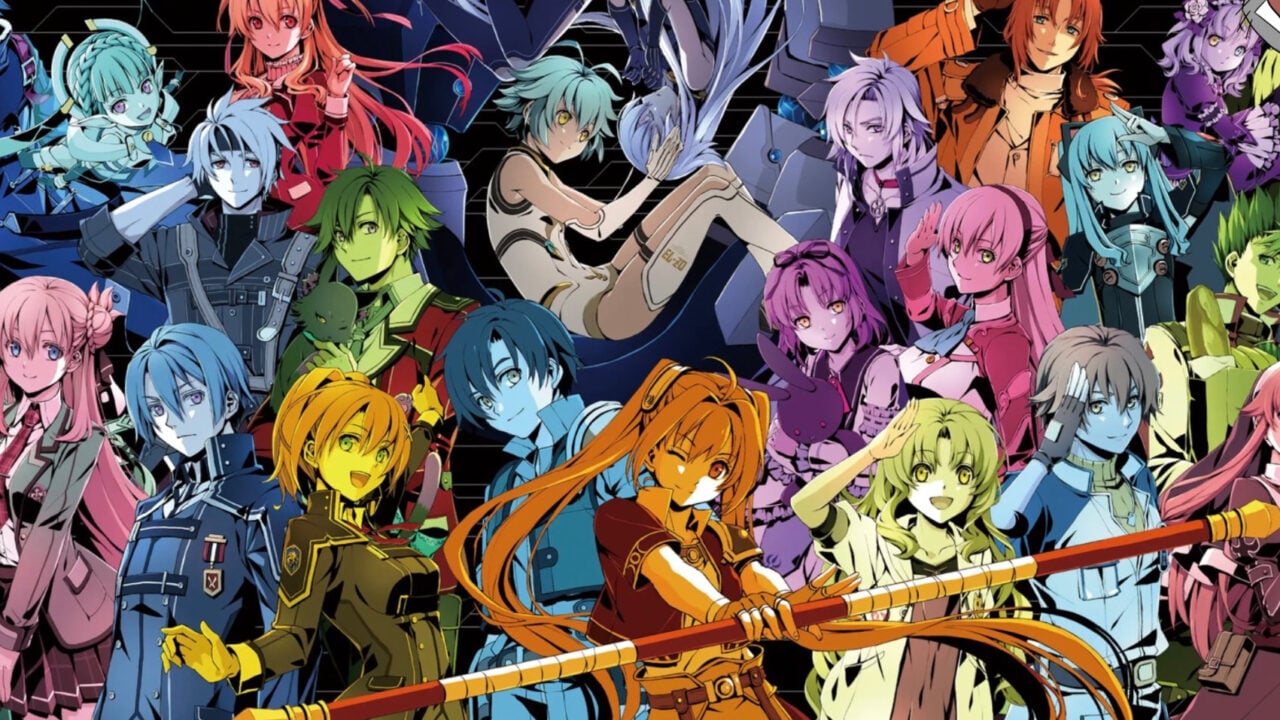
# Every Trails RPG, Ranked From Worst to Best
The Trails series stands as one of JRPG's most consistently rewarding franchises, spanning four distinct story arcs across nearly two decades. Falcom's interconnected narrative universe has grown from niche Japanese import to mainstream recognition, particularly after recent localization efforts finally made the entire saga accessible to Western players without fan translations or emulation workarounds.
The franchise splits cleanly into four story cycles. Sky Arc launched on PSP in 2004 with "Trails in the Sky," introducing Estelle and Joshua to a world that would expand dramatically across three games. Zero/Ao Arc followed, deepening worldbuilding through the eyes of Lloyd and the Special Support Section. Crossbell Arc (Zero no Kiseki and Ao no Kiseki) remained Japan-exclusive for years until NIS America localized both titles. Erebonia Arc delivered four mainline entries across PS3, PS4, and Switch, becoming the franchise's commercial peak. Calvard Arc represents the current frontier, with entries gradually localized.
Ranking these games involves balancing mechanical evolution against narrative coherence. Early Sky entries suffer from slower pacing and dated systems, yet their charm remains intact. The PSP originals move deliberately through Liberl, establishing the franchise's trademark combination of personal character arcs and continent-spanning conspiracies. Trails in the Sky the 3rd resolves the arc's biggest mysteries but drags in places, with some side content feeling obligatory.
Crossbell Arc games deliver tighter narratives than Sky's sprawl. Lloyd's journey through a city-state caught between empire and church proves more intimate than continent-hopping adventures. The setting's urban focus changes pacing fundamentally. Both Zero and Ao benefit from refined turn-based combat that emphasizes positioning and Orbment (magic system) customization. However, these games spent a decade unavailable in English, creating a generation of players who skipped them entirely despite their quality.
Erebonia Arc represents Falcom's ambition at maximum. The four Trails of Cold Steel entries escalated stakes relentlessly across PS3 and PS4, introducing aerial warships, military academies, and time-travel twists. Cold Steel III and IV specifically benefited from current-generation hardware, delivering environmental detail and character animations that prior entries couldn't match. The romance subplot expansion in Erebonia also attracted players seeking deeper character development alongside plot.
Calvard Arc entries (Trails into Reverie and the upcoming Trails through Daybreak II) represent the franchise's current direction. Reverie functions as a bridge narrative, pulling threads from all three prior arcs while introducing new protagonist Rean's successor story. These newer games benefit from player familiarity with Falcom's structural habits, meaning less exposition and faster narrative momentum.
For newcomers, Sky Arc remains the logical starting point despite its age. The PS Vita and PC versions hold up reasonably well. Series veterans typically rank Cold Steel III and IV highest due to production values and emotional payoff. Crossbell Arc games occupy a strange middle position, beloved by dedicated fans but sometimes overlooked by players who moved directly from Erebonia into Calvard.
Ranking individual entries proves less useful than understanding trajectory. The series genuinely improves with each cycle. Story complexity deepens, character development matures, and mechanical refinement accumulates. A player starting with Sky experiences a different game than someone beginning with Calvard, yet both paths lead to the same payoff: a franchise that respects player investment.