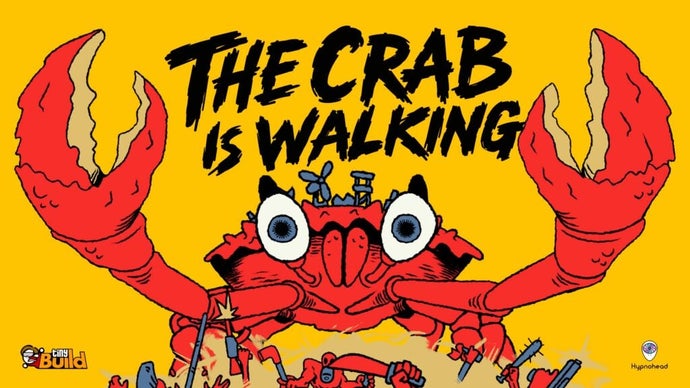
Hypnohead, the studio behind the gaze-mechanics puzzle game The King Is Watching, has announced The Crab Is Walking. The new project ditches the eye-tracking surveillance angle for a roguelite city-builder with absurdist combat systems and a fundamentally ridiculous core concept: building a metropolis on the back of a giant crustacean.
The game operates on a dual-loop design. Players arrange tetromino-shaped city districts across the crab's shell like a grid-based puzzle, constructing infrastructure and settlements. Then they deploy armies of what the studio calls "Mad Maxalots" to venture out into the wasteland and massacre insects. The back-and-forth between city planning and small-scale warfare creates a rhythm distinct from traditional city-builders, which typically focus on passive development and resource management.
The announcement explicitly notes what The Crab Is Walking removes from Hypnohead's previous work. The King Is Watching, released in 2023 to critical acclaim, forced players to maintain constant eye contact with their in-game civilization via webcam. Looking away caused your kingdom to deteriorate. It was a clever inversion of management game design, weaponizing player attention as a core mechanic. The Crab Is Walking abandons this concept entirely. Your crab city won't slack off if you blink. This design choice signals Hypnohead's willingness to experiment with form rather than iterate on proven formulas.
The roguelite classification indicates runs are procedurally generated and structured around multiple playthroughs. Death is permanent, but players unlock progression systems that carry forward across attempts. That structure pairs well with a city-builder format, where players rebuild from scratch each run but gradually unlock better starting conditions or advanced district types.
The tetromino-district system borrows shape-matching constraints from Tetris and its descendants. Arranging L-shaped, I-shaped, and square districts on a curved crab carapace introduces spatial puzzle-solving into city planning. Traditional city-builders offer expansive grids. Forcing players to work with specific shapes and a limited surface area creates tighter design problems. The crab itself becomes a character, not merely a platform. Its movement, size, and behavior shape every playthrough.
Combat against wasteland insects appears secondary to city management but essential for progression. Sending armies outward to fight suggests resource gathering and territorial control. Killing insects likely yields materials that fund district construction. The "Mad Maxalots" naming convention signals tongue-in-cheek post-apocalyptic theming, placing this squarely in the realm of deliberately silly game design rather than grim survivalism.
Hypnohead's shift from The King Is Watching's attention-based mechanics to The Crab Is Walking's puzzle-focused city-building reflects current indie trends. Studios that break through with a high-concept gimmick often expand into new territory rather than chase sequels. The roguelite city-builder space has room for fresh voices. Games like Spiritfarer and Dave the Diver proved indie audiences hunger for genre hybrids backed by genuine creativity, not just novel control schemes.
The Crab Is Walking exists in early development. No release date has been announced. Hypnohead's track record with The King Is Watching, however, positions them as designers willing to make weird work functionally. A crustacean city-builder where you fight insects is exactly the kind of pitch that required evidence of execution to reach audiences. That evidence exists.