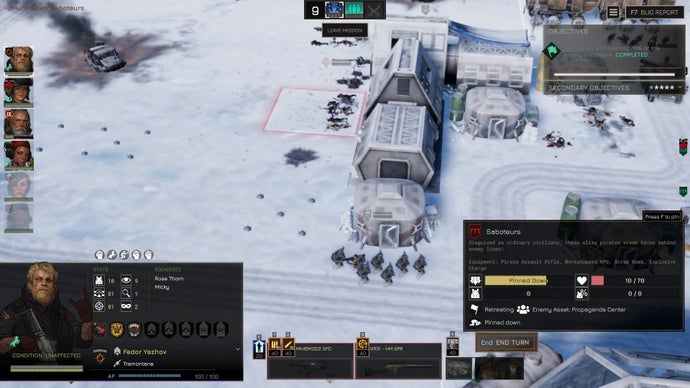
# Rally Point: Strong Simulation and Team Building Can't Carry Menace Forever
Menace arrives with solid fundamentals. The tactical simulation runs clean. Team building offers real depth. But somewhere between the promising foundation and extended playtime, friction builds.
The core complaint centers on what works initially becoming repetitive. Strong mechanics alone cannot sustain engagement across a full campaign. Menace nails the granular systems that appeal to hardcore strategy players. The team roster management feels weighty. Unit positioning matters. Resource allocation demands attention. These are not minor features bolted onto a hollow frame.
Yet execution falters where games typically need the strongest content. Mid-game progression plateaus. Challenge curves flatten. The very systems that establish early hooks become predictable loops. Players recognize patterns. Optimal builds crystallize. Once the novelty of discovery vanishes, Menace struggles to offer new reasons to engage with familiar mechanics.
This reveals a pattern in modern tactical simulations. Developers invest heavily in systemic depth but underestimate the narrative and pacing demands of full-length campaigns. Menace delivers simulation without sufficient context or momentum to justify the time commitment. The systems work. They simply lack the surrounding structure that transforms a toolset into an experience.
Rock Paper Shotgun's assessment cuts to the heart of this tension. A reviewer can respect what a game achieves while recognizing it fails to sustain that achievement across its full runtime. Menace illustrates this divide perfectly. The first fifteen hours sparkle with discovery and tactical possibility. The next thirty hours repeat those same pleasures with diminishing returns.
Team building remains the standout element. Constructing squads from available rosters, assigning roles, and watching those investments pay off in battle creates meaningful attachment. Losing favored units stings. Developing new talent provides milestones. This progression system taps into something primal about ownership and investment. But even this compelling layer cannot carry the entire experience on its back indefinitely.
The simulation quality deserves recognition. Menace respects player input. Randomization exists but never feels arbitrary. Tactical decisions produce logical outcomes. This faithfulness to simulation rules appeals to a specific audience that craves systems where mastery means understanding, not memorizing arbitrary design quirks. For that subset of strategy players, Menace delivers exactly what they want.
The problem arrives when that audience confronts the reality of extended play. Even excellent systems require variation, surprise, and escalation to maintain tension. Menace offers solid fundamentals without sufficient structural evolution. Boss encounters blend into regular skirmishes. Facility variations feel cosmetic rather than genuinely distinct. Enemy behavior patterns become readable. The challenge maintains a consistent difficulty rather than building toward climactic moments.
This shapes expectations for future tactical sims. Raw simulation strength matters less than understanding how to layer that strength with meaningful narrative progression, environmental variety, and pacing that respects player attention. Menace proves systems alone cannot solve game design problems. A team-building loop, however satisfying, needs companions.
The game exists in an awkward space where it's good enough to play but not compelling enough to finish. That's worse than being obviously flawed. Obvious flaws can be forgiven. A game that frustrates precisely because you recognize its potential triggers the most pointed criticism. Menace earned that criticism through competent execution of incomplete vision.