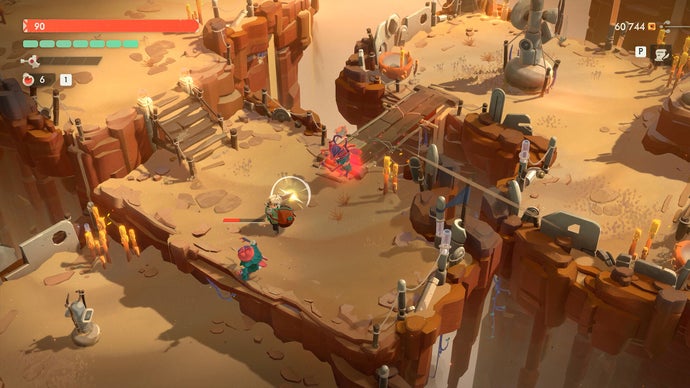
# Moonlighter 2: The Endless Vault Delivers a Roguelike Loop That Actually Respects Your Time
Moonlighter 2: The Endless Vault represents a substantial refinement of Digital Sun's dungeon-delving merchant fantasy. The sequel improves on its predecessor in ways that matter: pacing, progression clarity, and the core loop between combat and commerce now feels less like tedious busywork and more like genuine strategic decision-making.
The formula remains straightforward. Players control Will, a hybrid dungeoneer and shop owner who spends nights clearing randomly generated combat arenas and days selling the loot back in his boutique. Descend into shifting dungeons, fight monsters, collect treasures that barely fit in your bag, surface with goods, then negotiate prices in your shop. Repeat. Spend profits on upgrades that make you stronger, faster, richer. The cycle compounds.
What makes Moonlighter 2 work is its obsession with multipliers and exponential growth. Every decision feeds the meta-progression. Do you price that potion at 50 gold or 75? Should you invest in better bag space or combat stats first? Should you take that risky relic that could triple your dungeon haul or play conservatively? These questions drive engagement because the numbers respond visibly to your choices. Players will absolutely think about multipliers. That's the game's entire dopamine architecture.
The original Moonlighter launched in 2018 to modest acclaim. It nailed the core loop but suffered from friction. Long shop sequences dragged. Progression felt flat. The balance between combat challenge and economic strategy tilted awkwardly. Moonlighter 2: The Endless Vault addresses each of these complaints directly. Streamlined UI reduces downtime between activities. Relic system gives more agency in build crafting. The math behind pricing and profit margins now rewards player attention rather than punishing it.
On PC, PlayStation 5, Xbox Series X/S, and Nintendo Switch, the game targets players who enjoy incremental progression systems but lack patience for full roguelike commitment. It's accessible relative to harder entries in the genre. Death carries sting but not devastation. The rewind mechanic lets you undo bad decisions in dungeons without erasing runs entirely. This design choice democratizes the experience without gutting challenge for veterans.
The genre context matters here. Hades proved that roguelikes could achieve mainstream success. Dead Cells showed that commercial viability scales with consistent content updates. Slay the Spire demonstrated that economic simulation hooks players as hard as combat does. Moonlighter 2 absorbs all these lessons. It's not revolutionary. It's evolutionary.
The "number go up" criticism in the headline isn't dismissive, it's descriptive. The game is fundamentally about watching your stats climb, your wealth accumulate, your shop expand. There's no narrative campaign with story beats. There's no moral weight. Just the satisfaction of incremental optimization. For a specific audience, that's exactly the appeal.
Digital Sun clearly studied what worked in 2018 and what didn't. The Endless Vault subtitle hints at infinite replayability, which the roguelike structure supports. New runs feel distinct because relic combinations vary wildly. Shop prices shift based on economy state. Dungeon layouts randomize. The game respects that players might sink 50 hours here.
This is a sequel that understands its niche and executes confidently within it. It won't convert players indifferent to economic sims or roguelike loops. For fans of either or both, it's the best version of this concept yet.