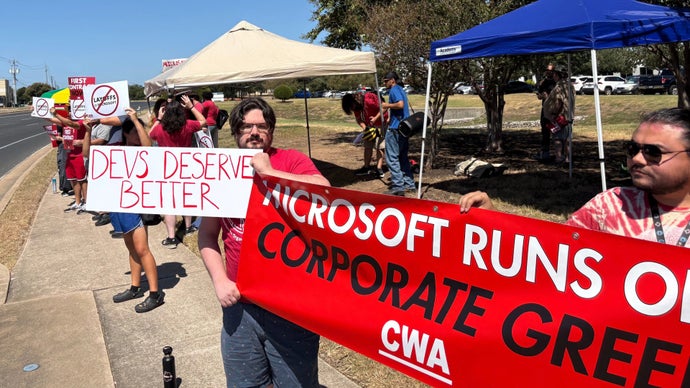
Microsoft's mass layoffs across its gaming division continue to draw organized resistance from unionized developers at Bethesda Game Studios. On August 18th, workers held rallies across North America under the One Bethesda Game Studio union banner, supported by the Communication Workers of America (CWA). The protests escalated beyond in-person demonstrations, with modders filling Fallout 4 with protest signs and vault suits bearing union logos in a creative show of solidarity.
The layoffs, announced in May 2024, eliminated positions across multiple Xbox-owned studios including Arkane Studios, Double Fine Productions, Undead Labs, Compulsion Games, and Ninja Theory. Bethesda Game Studios, the studio behind The Elder Scrolls and Fallout franchises, saw significant cuts that prompted unionization efforts in response.
A unionized Bethesda developer spoke directly to the studio's value proposition, stating "Without us, Bethesda games aren't Bethesda games." This statement captures the core grievance: the layoffs targeted experienced developers whose creative input defines the studio's output. Bethesda's open-world design philosophy, modding support infrastructure, and narrative complexity depend on institutional knowledge that takes years to develop.
The OneBGS union, which represents Bethesda's workforce, reports morale "on the upswing" despite ongoing uncertainty. This resilience reflects a shift in labor organizing within the gaming industry. Previous unionization attempts at studios like Activision Blizzard and Raven Software faced skepticism, but Bethesda's effort gained traction during a period of broader industry contraction. The union framed resistance not as opposition to Xbox's business decisions alone, but as advocacy for workers' rights in an industry known for crunch culture and precarious employment.
The Fallout 4 modding campaign proved particularly effective as a protest vector. Fan-created mods placed vault suits bearing OneBGS logos and protest messaging directly into players' game worlds. This blurred the line between developer activism and player solidarity. Many fans recognize that the developers who shipped Skyrim in 2011 and Fallout 4 in 2015 shaped their gaming experiences, and layoffs threaten future titles' quality.
Microsoft faces a specific credibility challenge. The company acquired Bethesda Game Studios in 2021 for $7.5 billion, positioning the studio as a cornerstone of Xbox Game Pass and future franchise entries. Yet the subsequent layoffs signaled that ownership did not guarantee employment stability. Industry observers note the irony: Microsoft spent heavily to secure Bethesda's intellectual property only to reduce the human capital necessary to develop new Elder Scrolls and Fallout games.
The CWA's involvement expanded the protest beyond Bethesda. The union has pushed for standardized labor protections across the gaming industry, connecting Bethesda's situation to broader systemic issues. Game developers work longer hours than comparable software engineers, face lower median salaries, and endure "at-will" employment with minimal severance.
Unionization at Bethesda carries implications beyond compensation. The studio's creative culture, built over 25 years, depends on retaining veterans who understand franchise DNA. Developers departing during layoffs take institutional knowledge with them. Replacement hires require months of onboarding before contributing meaningfully to complex systems design.
The rallies and modding campaign suggest the conflict will remain visible. Players and developers occupy the same attention space, and labor disputes now translate into cultural messaging that reaches audiences directly. Microsoft must balance cost management against the narrative damage of cutting the studio responsible for two of gaming's most beloved franchises.