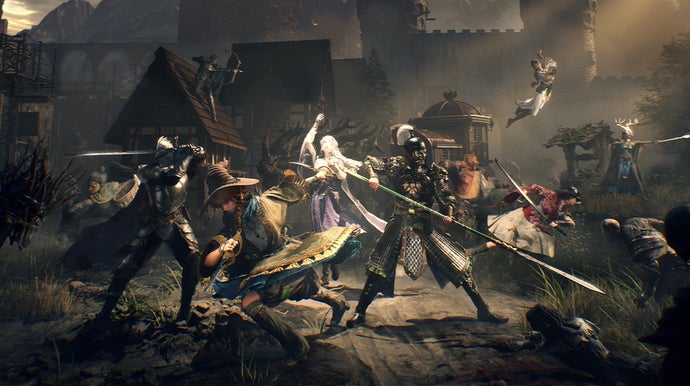
Among Shadows blends dark fantasy action-RPG combat with social deduction mechanics borrowed from Among Us, creating an unusual hybrid that pulls inspiration from Elden Ring: Nightreign's challenging swordplay. The game tasks players with investigating a supernaturally corrupted region as members of the Order of the Secret Fire, hunting down sources of blight while managing gear progression and leveling systems typical of action-RPGs.
The core pitch combines multiple genres into a single package. Players engage in Dark Souls-adjacent combat encounters in hostile terrain, but the social deduction layer introduces trust and betrayal mechanics. The Among Us formula applied to a fantasy RPG setting means players must identify corrupted agents within their ranks while simultaneously fighting external threats. This creates dual pressure, forcing attention both inward at teammates and outward at environmental dangers.
The comparison to Elden Ring: Nightreign matters here. FromSoftware's roguelike expansion emphasizes punishing combat and environmental design, rewarding player skill and pattern recognition. Among Shadows appears to adopt similar combat philosophy, where positioning, stamina management, and attack timing determine survival. The "swordwizarding" reference suggests melee combat layered with magical systems, likely offering build variety and playstyle options.
The social deduction angle introduces a wildcard element. In Among Us, players vote to eliminate suspected impostors while impostors work to sabotage the group. Among Shadows transplants this mechanic into an RPG context where corruption or betrayal exists as a genuine threat. Corrupted players might actively work against the group's objectives, or subtle gameplay mechanics might reveal trustworthiness through action rather than accusation. This creates tension beyond combat encounters, forcing groups to question each other's motives and reliability.
The disease and betrayal themes run deeper than surface mechanics. A blighted region populated with corrupted enemies and potentially corrupted players speaks to a world actively hostile to the player faction. The Order of the Secret Fire sends agents into this nightmare, but how many return uncorrupted? The setting implies that survival means not just defeating external threats but identifying and managing internal rot.
The loot-and-level structure grounds the experience in familiar RPG progression. Players hunt gear upgrades and stat increases, standard expectations for the genre. This foundation provides structure and reward loops that keep progression visible and satisfying, something Elden Ring: Nightreign demonstrates effectively across its campaign.
What makes Among Shadows interesting rather than merely experimental is the apparent commitment to all three components. Too many genre mashups fail because one element dominates while others feel tacked on. A social deduction mechanic grafted onto an action-RPG could easily become tedious busywork, but the emphasis on disease, corruption, and betrayal suggests the developers designed the social layer as thematically integral rather than cosmetic. When mechanics align with narrative, hybrid games work.
The skepticism is warranted. Genre arithmetic often fails. Elden Ring: Nightreign succeeded by understanding what players loved about FromSoftware's formula and adapting those principles to roguelike structure. Among Shadows faces the harder challenge of balancing three distinct systems simultaneously without letting any cannibalize the others. The combat cannot feel shallow, the deduction cannot feel arbitrary, and the progression cannot feel disconnected from both.
If the execution lands, Among Shadows could define a new subgenre. If it stumbles, it becomes a cautionary tale about ambition exceeding scope. The framework exists. The premise resonates. Everything depends on how cleanly the developers integrate these disparate pieces into a cohesive whole.