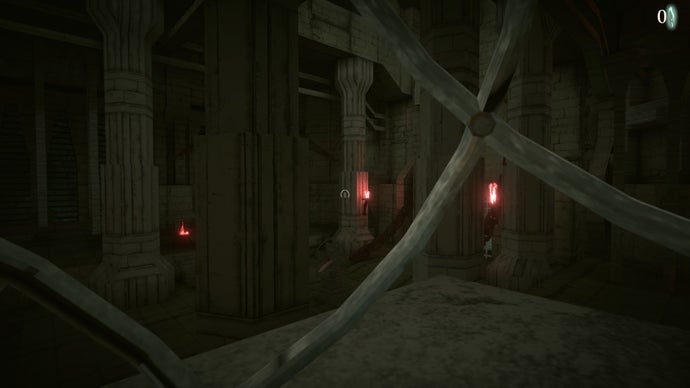
The Canon of Balls rolls onto the scene as one of 2025's most audacious indie platformers, blending the punishing difficulty of Dark Souls with the rolling momentum mechanics of Super Monkey Ball inside a sprawling open world. Developer ambition runs high here. The game tasks players with controlling a horrified stone face, complete with a fleshy pink tongue that doubles as a springboard, floating inside a rolling cage through interconnected environments.
The inspirations stack deliberately. Dark Souls contributes the oppressive atmosphere and unforgiving combat tuning. Super Monkey Ball provides the physics-based rolling mechanics that define moment-to-moment traversal. Fumito Ueda's work, likely referencing Shadow of the Colossus, brings a dark, architectural sensibility to level design. Minecraft parkour elements enable vertical exploration and player-directed progression through structured environments that reward experimentation.
What emerges is genuinely odd. The core loop involves navigating the cage through landscapes that combine gothic darkness with surreal geometry. Your tongue becomes both weapon and tool. Launch yourself across gaps. Push back against environmental hazards. Die repeatedly to learn attack patterns and terrain rhythms. The rolling mechanic adds unpredictability absent from traditional platformers. Momentum carries you forward even when you stop inputting commands. This demands precision and planning several moves ahead.
The open world structure breaks from Dark Souls' path-forward design. Players can approach challenges in varied orders. Certain boss encounters may demand equipment or techniques unlocked elsewhere. Backtracking isn't punishment but exploration opportunity. Dead ends frequently hide shortcuts or resources. This mirrors Minecraft's sandbox philosophy, where players carve individual paths through shared space.
Visually, the game embraces gothic industrial architecture. Sprawling cathedrals. Rusted platforms. Bone structures. The fleshy pink tongue contrasts violently against this grimness, creating deliberate visual discomfort. This aesthetic choice reflects Ueda's signature approach to juxtaposing beauty and horror.
The market for challenging indie platformers remains strong. Hollow Knight, Salt and Sanctuary, and Blasphemous all proved audiences crave difficulty married to artistic vision. The Canon of Balls targets this demographic directly. It asks players to accept unconventional controls and bizarre aesthetics in exchange for genuine mechanical depth.
Success depends on whether the rolling physics feel responsive or sluggish. Super Monkey Ball's momentum carries weight and consequence. Players feel the cage's inertia. Every input matters. If The Canon of Balls matches that precision, it becomes a sleeper hit. If controls feel muddled, the game drowns under its own weirdness.
Platformers have cycled through countless gimmicks. Ball rolling, gravity flipping, time manipulation. What separates failures from classics is execution. The Canon of Balls possesses the pedigree. Dark Souls proved modern audiences embrace difficulty when tied to meaningful progression. Minecraft proved open-world exploration need not follow triple-A formulas. Super Monkey Ball proved rolling mechanics deserve modern revival.
The real test arrives with launch. Reviewers will measure whether this weird amalgamation coheres into something playable or becomes an exercise in fetishizing obscurity. Either way, The Canon of Balls represents the kind of risk-taking that keeps indie gaming vital.