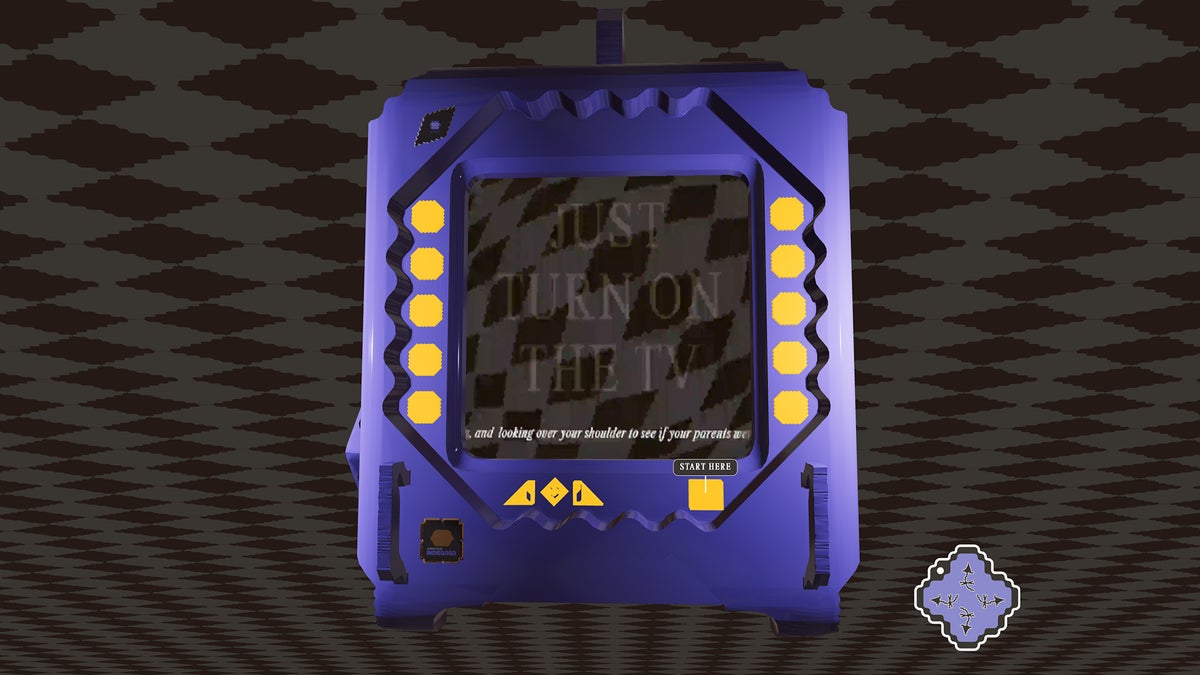
Public-access television represented something radical: the democratization of broadcast media. Anyone could theoretically create and share their work with an audience. That vision largely died with the internet's rise, but NIGHTEYE.TV is attempting to resurrect it for a new generation—and for a medium that actually needs it. The platform, currently live at www.nighteye.tv, presents itself as a fake TV floating in a Unity default texture void with a distinctly Backroomsian vibe. It's deliberately unsettling, which is precisely the point.
What makes NIGHTEYE.TV compelling isn't its aesthetic novelty, though that helps. It's the curation. The platform currently features art games of decidedly unconventional sensibilities—Nathalie Lawhead's Everything is Going to Be OK, Jeremy Couillard's Soul Injector Commando, and Taylor McCue's He Fucked The Girl Out Of Me—presented as a collection of clips and playthroughs. These aren't mainstream titles fighting for shelf space on Steam's algorithm-driven storefront. They're the weird, unmarketable work that traditional distribution channels systematically exclude. By assembling them under one digital roof, NIGHTEYE.TV creates context and community around art games that would otherwise languish in obscurity.
The revenue model deserves particular praise. When the platform reaches full operational status—currently being funded through an Indiegogo campaign—most sale proceeds will return directly to artists. The structure allocates 15% to a community pool split amongst all contributors, with another 15% funding platform operations. This isn't extraction. This is sustainability built on actual respect for creators. Compare that to how most digital storefronts operate, and you see why this matters.
Still, NIGHTEYE.TV faces real challenges. Its current incarnation is mostly clips with hidden menu links to full games—functional but not yet the rotating, curated marketplace it aims to become. The Indiegogo campaign is crucial to bridging that gap. The platform needs to prove it can scale while maintaining its editorial integrity and creator-first philosophy.
Public-access television worked because it believed anyone with something to say deserved an audience. NIGHTEYE.TV extends that principle to artists whose work the commercial mainstream has deemed unmarketable. In an era where algorithmic recommendations homogenize gaming culture, that's genuinely subversive. The question isn't whether NIGHTEYE.TV will succeed—it's whether enough people recognize how urgently we need platforms like this to survive.