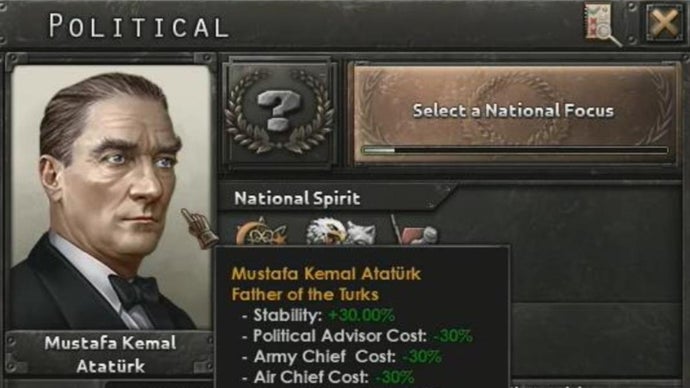
Paradox Interactive, the developer behind Hearts of Iron IV, has implemented a new Discord policy banning profile pictures of historical figures born after January 1, 1800, excluding official in-game portraits. The sweeping restriction emerged after community backlash when a moderator banned a player for using a photograph of Mustafa Kemal Atatürk, the founder of modern Turkey, as their profile picture.
Game director Laszlo "Batya" Pieper acknowledged the handling of the initial incident in a Discord statement, saying "We clearly handled that responsibility poorly." The policy carves out an exception: players may still use official Hearts of Iron IV in-game portraits of post-1800 figures, with a specific exclusion for prominent leaders of Nazi Germany.
The controversy centers on content moderation in one of gaming's most niche and historically sensitive communities. Hearts of Iron IV attracts a dedicated audience of grand strategy fans who engage deeply with 20th century history. The game simulates World War II and alternate history scenarios, drawing players with serious historical interests alongside those exploring counterfactual timelines. Moderating such spaces requires careful judgment about what constitutes acceptable historical representation versus glorification.
The Atatürk incident triggered significant player criticism. Atatürk remains a foundational figure in Turkish national identity, and banning imagery associated with him appeared heavy-handed to community members who viewed the decision as culturally insensitive. The backlash forced Paradox to revisit its moderation approach, but the resulting blanket ban on post-1800 historical figure photos creates its own problems.
The new policy essentially treats all post-1800 historical photographs as equally problematic, regardless of context. This catches legitimate historical discussion in its net. Players discussing Churchill, de Gaulle, Stalin, or countless other consequential figures cannot display their photographs. The rule applies uniformly, which sidesteps the need for contextual judgment but eliminates nuance entirely.
Paradox framed the exception for official in-game portraits as a compromise. These portraits exist within the game's controlled context and represent vetted historical imagery. The Nazi Germany exclusion reflects particular sensitivity around that period's glorification risks, a reasonable boundary that acknowledges certain figures warrant heightened scrutiny.
This represents a broader challenge facing online gaming communities. Moderation teams must balance historical discussion, prevent genuine extremism, and avoid appearing censorious. Hearts of Iron IV's audience includes serious history enthusiasts, alternative history fans, and players exploring geopolitical simulation. Treating all historical imagery identically fails to account for why someone displays a particular figure.
The policy's effectiveness remains uncertain. Banning photographs doesn't prevent discussion of controversial figures; it simply removes one visual medium. Players interested in problematic ideologies can still engage with them through text, in-game mechanics, or other channels. Meanwhile, the blanket approach may frustrate legitimate history discussions and players seeking to celebrate non-Western historical leaders.
Paradox's decision reflects the difficulty of scaling content moderation across large communities. Hiring trained moderators capable of contextual judgment costs more than implementing automated rules. The company chose standardization over nuance, trading precision for consistency and reduced liability.