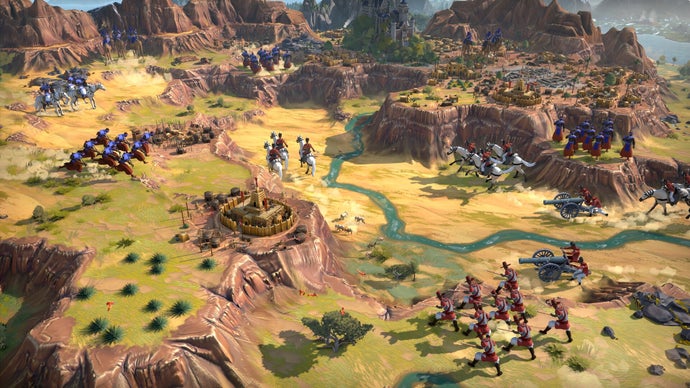
The 4X strategy genre faces a persistent design challenge that emerges early in every game's lifecycle: the "explore" pillar collapses once players map the world. Amplitude Studios has spent over a decade wrestling with this problem, starting with Endless Legend in 2014, and the studio's approach reveals how different developers tackle the same fundamental issue.
Romain de Waubert de Genlis, Amplitude's co-founder and CEO, frames this as an "inherent problem" embedded in the genre's DNA. Once you've uncovered the map, exploration stops being a meaningful mechanic. But the issue runs deeper than fog of war mechanics. Strategic exploration also refers to the abstract unpredictability that keeps players experimenting with tactics. Once you've spotted all resources, identified every enemy faction, and assessed available terrain, your strategic options calcify. You commit to a course of action and rarely deviate, turning late-game 4X into execution rather than discovery.
This design trap has trapped countless titles. Players experience peak engagement during the early game when every tile reveal sparks decisions. By turn 100, most 4X games become predictable. Victory conditions feel inevitable or impossible. The back half of a 12-hour campaign transforms into rote resource management and unit positioning.
Amplitude's Endless Legend attempted solutions through asymmetric faction design and narrative events that disrupted player plans. Humankind, the studio's more recent 4X, layers cultural progression systems that force strategic reinvention across eras. Neither game entirely solves the exploration problem, but both acknowledge that raw map discovery alone cannot sustain the "explore" pillar for 400 turns.
Other studios deploy different remedies. Civilization VI uses Wonder races, technological surprises, and barbarian invasions to inject late-game uncertainty. Total War Warhammer III embraces faction-specific endgame goals that shift strategic priorities. Crusader Kings III abandons traditional map exploration entirely, instead framing discovery as dynastic intrigue and succession crises.
The most successful approach combines hidden information with dynamic events. Endless Space 3 uses procedural anomalies and rival faction movements to ensure the galactic map never becomes fully knowable. Europa Universalis IV maintains exploration through diplomatic discovery and religious upheaval. These games understand that "explore" doesn't require new terrain. It requires persistent unknowns.
The challenge for Amplitude and its competitors intensifies as games grow longer. Expansion packs add new mechanics, but they rarely solve the core problem. A 400-turn Humankind campaign will still feel tedious by turn 300 regardless of how many cultural mechanics exist. Players need reasons to scout, research blind alleys, and take calculated risks throughout the entire experience.
Fixing this requires rethinking endgame structure entirely. Some developers experiment with random event systems that spike late-game tension. Others add time-limited objectives that force strategic pivots. A few innovators like Crusader Kings III simply truncate the endgame, accepting that player interest naturally declines.
Amplitude's willingness to acknowledge this as an "inherent problem" rather than poor game design signals a maturing industry. 4X developers now recognize that exploration fatigue isn't a bug to patch but a feature to manage. Whether through hidden information, dynamic systems, or structural redesigns, solving disappearing exploration remains the genre's next frontier.