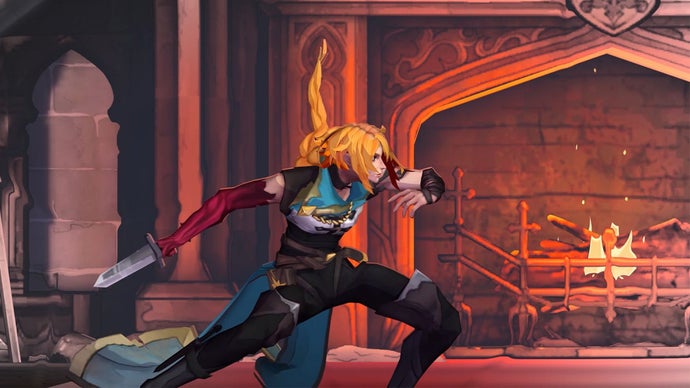
Evil Empire, the French indie studio behind the roguelike phenomenon Dead Cells, has delivered a confident revival of Konami's legendary Castlevania franchise with Belmont's Curse. The game marks the series' return after a decade of dormancy, and it signals that Konami made the right call handing the reins to the team that perfected procedural combat on indie scale.
The setup frames Rose Belmont, daughter of the famous vampire hunter Trevor, as she sails into a monster-ravaged Paris alongside her father. Trevor's reassurance that "you're not the last Belmont anymore" establishes the narrative hook. Rose steps into her family's legacy not as a solo survivor but as part of a new generation. Evil Empire builds from this premise with the confidence of a studio that knows how to craft engaging action gameplay.
Evil Empire's credentials run deep here. Dead Cells transformed roguelike design into an art form, blending fast-paced melee combat with environmental variety and constant progression loops that kept players engaged across hundreds of hours. The studio even created official Castlevania DLC for Dead Cells, which served as a proof of concept that they understood the series' DNA. That DLC demonstrated their ability to marry the whip-based combat of the Belmonts with roguelike mechanics without diluting either.
Belmont's Curse appears to leverage that expertise fully. The game sits at the intersection of classic Castlevania's gothic atmosphere and action-platformer sensibilities with the modern design philosophy that made Dead Cells resonate with players across PC, console, and mobile platforms. Evil Empire clearly respects the source material while refusing to simply recreate what came before.
Konami's decision to license the Castlevania IP to an indie team rather than assign it to an internal studio or AAA partner reflects changing industry dynamics. The company has struggled to maintain momentum on legacy franchises in recent years. By trusting Evil Empire, Konami placed the series in hands that proved they could balance innovation with reverence for existing fanbases. This mirrors successful revivals like how Devolver Digital's involvement elevated smaller IP into cultural moments.
The timing matters as well. Castlevania has enjoyed a cultural resurgence through Netflix's animated adaptations, which kept the property in public consciousness despite game releases slowing to a halt. Belmont's Curse launches into that renewed interest, capitalizing on nostalgia while introducing the series to players who discovered it through the shows rather than the games.
For Evil Empire, this represents a significant step up in scope and responsibility. Dead Cells succeeded because the studio nailed moment-to-moment gameplay and respected player time through meaningful progression. Now they apply those principles to an established universe with decades of lore and fan expectations. Early reactions suggest they've managed that balance, holding the weight of Castlevania's legacy without buckling under pressure.
The game's existence on multiple platforms remains unconfirmed in this excerpt, but Evil Empire's track record suggests wide distribution across PC, PlayStation, Xbox, and Nintendo Switch is likely. The studio understands that indie roguelikes thrive when accessible across devices.
Belmont's Curse stands as validation that legacy IP revivals don't require massive budgets or established studios. Smart design, respect for source material, and proven gameplay chops can breathe new life into dormant franchises. Evil Empire proved this formula works, and Castlevania fans have a reason to return to Dracula's castle.