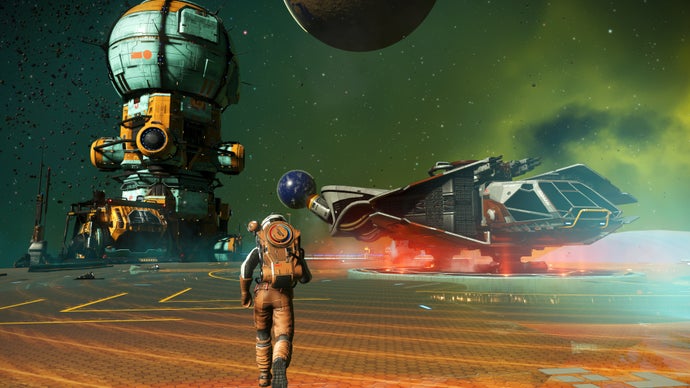
No Man's Sky marks a decade since its contentious 2016 launch, and Hello Games is celebrating with the Cosmos update. This expansion introduces three major systems that reshape how players interact with the procedurally-generated universe.
The headline feature lets players assume control of space stations as directors. This goes beyond the previous observer role. Players now manage station operations, make administrative decisions, and shape the infrastructure around them. The mechanic transforms stations from static waypoints into player-owned territories with genuine strategic depth. Station ownership creates a new endgame loop for veterans who exhausted exploration and resource grinding.
Floating orbital bases represent the second pillar. Players can now construct habitats in space itself, detached from planetary surfaces. This opens colonization possibilities beyond traditional groundside settlements. Orbital structures serve dual purposes: functional infrastructure for resource processing and aesthetic showpiece construction for creative players. The system appeals to both utilitarian builders and decorators, two distinct player demographics within No Man's Sky's audience.
The third feature, dubbed "holiday to the sun," lets players travel directly to stellar objects. No Man's Sky previously kept stars as distant navigation points. The Cosmos update allows direct visitation with appropriate ship upgrades and hazard protections. This satisfies years of player requests to experience the universe's scale more intimately. Proximity to a star introduces new environmental hazards and visual spectacle, rewarding risk-taking exploration.
These systems reflect Hello Games' decade-long philosophy of continuous expansion. No Man's Sky launched with significant feature gaps that created player backlash. The studio spent the next ten years methodically adding content: base building (Origins, 2020), freighter captaincy (Frontiers, 2021), settlement management (Endurance, 2023). Each major update addresses community wishlist items with mechanical depth rather than surface-level additions.
The Cosmos update lands during a competitive period for space-exploration games. Star Citizen remains in perpetual development with contested monetization practices. Starfield launched in 2023 but faced criticism for restrictive procedural generation compared to No Man's Sky's infinite universe. Elite Dangerous pivots toward online multiplayer. No Man's Sky's single-player focus and accessibility create distinct market positioning.
Player reception matters here. No Man's Sky maintains healthy concurrent player counts across PC, PlayStation, and Xbox platforms. The community remains engaged despite the game's age. Each major update generates renewed interest from lapsed players, a proven pattern. The Cosmos update targets both returning and continuous players, offering fresh progression paths without resetting existing progress.
Sean Murray and Hello Games operate No Man's Sky at a scale most indie studios cannot match. With a dedicated team and player funding through cosmetic purchases, the studio continues expanding scope. This contrasts sharply with the industry trend toward early access abandonment or minimal post-launch support.
The 10th anniversary update represents No Man's Sky's position as a completed game that refuses to become stale. The Cosmos update delivers substantial mechanical additions rather than seasonal cosmetics or battle pass cycles. For a game that launched as industry punchline, that trajectory toward persistent evolution remains noteworthy within live-service gaming standards.