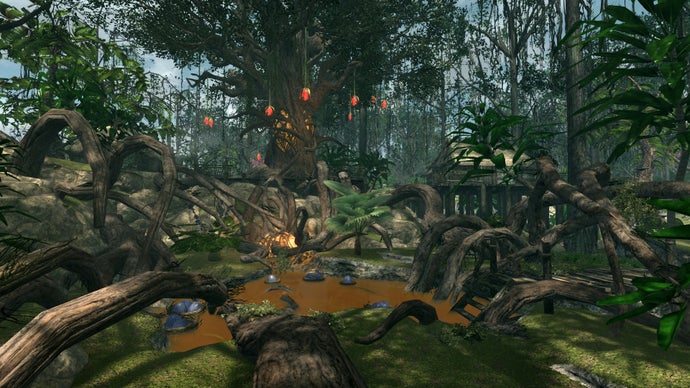
The creator behind King of the Murkmire, an ambitious DLC-sized expansion mod for Skyrim, is pushing back against the industry's rush toward generative AI. The mod transports players to Black Marsh, the Argonian homeland, featuring hist trees, dense swamps, and quest content that rivals official expansions in scope. Its developer used traditional modding techniques exclusively, completing the project without any reliance on AI-generated assets or writing.
This stance arrives at a pivotal moment for game modding. The past two years have seen heated debates over AI integration in creative communities. Some modders have experimented with AI for asset generation, voice acting, and dialogue. Others have rejected the practice entirely, viewing it as both artistically hollow and potentially damaging to modder livelihoods. King of the Murkmire's existence serves as a direct counter-argument: polished, feature-rich mods still emerge from human creativity and skill alone.
Skyrim modding remains one of gaming's most vibrant communities. The game launched in 2011 yet generates thousands of mods annually across PC, consoles, and VR platforms. Nexus Mods, the primary distribution hub, hosts over 100,000 Skyrim modifications. From quest expansions to total conversion overhauls, the range spans imagination's full spectrum. King of the Murkmire positions itself within this tradition of ambitious fan-made content, but its creator intentionally frames it as a rebuttal to creeping AI adoption.
The Black Marsh expansion includes multiple quests, new locations with hand-crafted environments, and dialogue written entirely by its developer. The modder likely spent hundreds of hours on design, scripting, testing, and iterative refinement. This labor-intensive approach contrasts sharply with shortcuts that AI tools promise. Tools like ChatGPT or Midjourney could theoretically accelerate asset creation, but quality control remains a problem. AI-generated dialogue often feels generic. AI art sometimes breaks spatial logic or fails anatomical consistency. For hardcore Skyrim players accustomed to professional-grade community work, these compromises register immediately.
The broader industry context amplifies this mod's message. Major studios face backlash over AI art in games. Concord's failure partly stemmed from controversy surrounding character design. Stability AI and other generative platforms face lawsuits from artists and authors. Meanwhile, modders remain divided. Some view AI as a democratizing tool that lowers barriers for amateur creators. Others see it as a threat to craftsmanship and fair compensation for asset creators.
King of the Murkmire demonstrates that ambitious scope does not require AI shortcuts. Solo and small-team modders continue producing work of remarkable quality through traditional development methods. The expansion's existence matters not just as a mod, but as a statement within ongoing conversations about creative practice in 2026.
For Skyrim's player base, King of the Murkmire offers what they expect: fresh content with environmental detail and narrative depth. For the modding community, it represents one creator's deliberate choice to prove that excellence remains possible without algorithmic assistance. Whether this stance becomes industry standard or niche remains unclear, but the mod's arrival signals that the human-made alternative still commands serious respect.