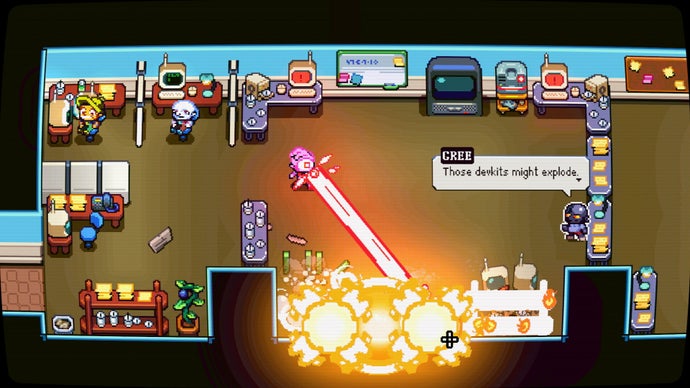
Laser Guy flips the twin-stick shooter formula on its head with a premise rooted in workplace anxiety and involuntary laser vision. The game casts players as a stressed game developer who can't control the constant beam of energy firing from his eye, forcing him to navigate an office environment without obliterating his coworkers. This "anti-shooter" design inverts the genre's typical power fantasy of consequence-free destruction into a puzzle of restraint and precision.
The concept draws obvious inspiration from Cyclops of the X-Men, whose uncontrollable optic blasts require permanent ruby-quartz lenses to function in society. Laser Guy weaponizes that limitation into its core mechanic. Players must manage the constant laser output while moving through office spaces, using environmental obstacles and careful positioning to avoid collateral damage. Rather than maximizing kills, success means keeping your involuntary weapon trained away from targets you shouldn't hit.
This design philosophy represents a growing trend in indie development toward subverting established game conventions. While mainstream twin-stick shooters like Enter the Gungeon, Vampire Survivors, and Robotron 2084 center on offensive power and enemy elimination, Laser Guy reframes the genre as one requiring defensive thinking and spatial awareness. The game asks players to treat their primary weapon as a liability rather than an asset.
The workplace setting amplifies the comedy. Office environments in games typically serve as tutorial spaces or mundane backdrops. Laser Guy makes the cubicle hellscape central to the challenge. Colleagues become obstacles not because they're hostile, but because they're just trying to work. The stressed developer protagonist resonates with game industry workers burned out from crunch cycles and corporate dysfunction. The involuntary laser becomes a physical manifestation of uncontrolled stress responses.
Twin-stick controls feel like the obvious choice for this mechanic. Players use one stick to move and another to aim, but aim management becomes the actual puzzle rather than aim skill. Most twin-stick shooters demand rapid reflexes and constant shooting. Laser Guy demands patience and restraint. This reversal creates mechanical novelty without requiring exotic control schemes.
The term "anti-shooter" carries weight in indie circles. Games like Baba Is You, The Witness, and Outer Wilds earned critical acclaim by subverting the expectations of their nominal genres. Anti-shooters haven't established themselves as a recognized subgenre yet, but Laser Guy plants a flag. If executed well, it demonstrates that familiar mechanics can generate fresh experiences through ideological inversion.
The game's success depends on whether its concept sustains gameplay depth across multiple levels. A single joke, however clever, needs solid puzzle design underneath. Environmental variety, escalating difficulty, and new mechanic introductions will determine whether players stick around or bounce off after the premise wears thin.
Laser Guy launches from a studio willing to experiment with audience expectations during a period when indie games drive the most creative risks. Whether this particular anti-shooter finds an audience depends on execution, but the concept alone proves the twin-stick formula has untapped potential for designers willing to question its fundamental assumptions.