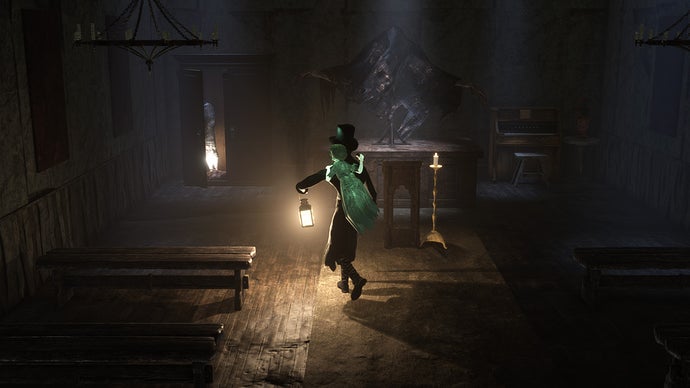
Withering Realms launches in early access today as a standalone sequel to the cult indie hit Withering Rooms. Developer Hollow Ponds pushes the formula further with a 1920s alt-history setting where World War 1 ended abruptly due to occult interference. The premise alone signals ambition: players control a ghost child riding the shoulders of a grotesque living marionette, a mechanical creature built from springs, hinges, and unsettling anatomy that recalls the stop-motion horror of Phil Tippett's Mad God.
The game blends top-down Zelda-style dungeon exploration with Bloodborne's deliberate, punishing combat. That fusion appeals to a growing audience tired of genre conventions. Withering Rooms proved this formula resonates. It delivered dollhouse horror wrapped around solid action mechanics, creating something that felt both intimate and ominous. Withering Realms expands that vision into a larger world while maintaining the dread that made the original compelling.
The marionette-as-mount design creates mechanical gameplay advantages beyond atmosphere. Riding the creature provides height and reach advantages in combat while the ghost child passenger handles interactions and magic. This two-body system splits player agency in ways traditional action RPGs don't explore. Combat demands precision. Enemies punish careless aggression. Exploration rewards patience and observation, hallmarks of Souls-like design applied to isometric perspective.
The 1920s setting matters more than window dressing. Interwar aesthetics marry naturally with body horror and occult themes. Art Deco architecture clashes against twisted organic growth. This creates visual contrast that enhances environmental storytelling without relying on exposition dumps. The world communicates its catastrophe through design.
Early access timing positions Withering Realms within indie momentum. Hollow Ponds carries credibility from Withering Rooms' reception. The studio operates in a space occupied by studios like Nomada Studio and Annapurna Interactive's portfolio. These developers prove that niche action RPGs find audiences when they deliver craft and genuine artistic vision.
The marionette's design itself becomes the hook. That one-eyed, spring-loaded monstrosity will appear in every screenshot, every stream, every piece of marketing. It's memorable in ways standard fantasy protagonists aren't. Players tire of beautiful heroes and standard chosen ones. A ghost child clinging to a mechanical horror offers something different. It promises vulnerability wrapped in strangeness.
Combat clarity remains critical for early access success. Souls-like games live or die on readable attack patterns and fair hitboxes. Withering Realms inherits Bloodborne's template, meaning tight feedback loops matter enormously. Top-down perspective changes sightlines compared to third-person action games. Depth perception shifts. The early access period will determine whether spacing and range feel intuitive or frustrating.
The early access model serves Withering Realms well. Player feedback shapes genre games. Hollow Ponds gains months of iteration before full launch. Communities form around unfinished projects, creating organic hype. Early adopters become advocates if the core experience delivers satisfaction.
Withering Realms launches on PC via Steam. Console versions likely follow once development stabilizes. The game targets players burnt out on Souls-like saturation who crave stylistic and mechanical variation. A grotesque marionette shouldering a ghost child into twisted 1920s occult horror provides exactly that variation.