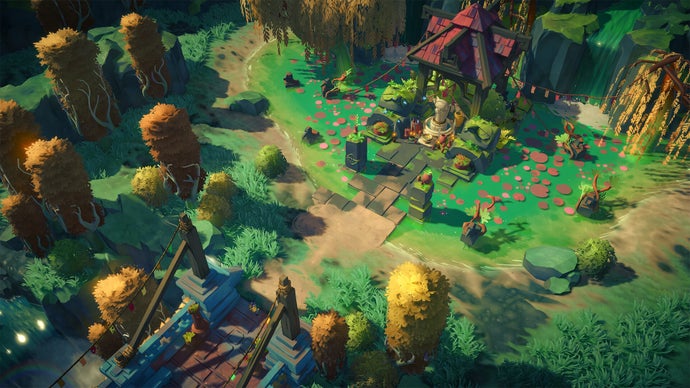
Annapurna Interactive and developer Graceful Decay are introducing Uncanyon, a puzzle game that bends spatial reality in ways that harken back to the mind-bending design philosophy of Maquette, their 2021 debut.
Uncanyon operates on a "puzzle-first" foundation where the environment itself becomes the puzzle. Players reshape the world beneath their feet by manipulating impossible geometry and non-Euclidean space. The game takes place in the seam between parallel realities, areas where the laws of physics bend and conventional spatial logic breaks down. This setup allows Graceful Decay to explore environmental storytelling through pure mechanical interaction rather than exposition dumps or cutscenes.
The studio built credibility with Maquette, a first-person puzzle game that explored recursive architecture and impossible spaces. That game challenged players to think in three dimensions while manipulating scale and perspective. Uncanyon appears to push that concept further. The core loop involves observing how the environment transforms, then using those changes to progress. Rather than collecting items or solving lock-and-key puzzles in traditional ways, players navigate worlds that actively shift and reconfigure.
What sets Uncanyon apart in a crowded puzzle space is its commitment to environmental transformation as core mechanic. Games like The Witness and Portal established spatial puzzle design as high art, but they relied on fixed spaces with discrete solutions. Uncanyon's constantly morphing terrain suggests puzzle solutions emerge from understanding how reality itself bends in these parallel zones. This creates a sense of discovery that many modern puzzlers struggle to achieve.
Graceful Decay's approach aligns with a growing trend in indie puzzle design where visual spectacle and mechanical innovation intertwine. Studies like Maquette prove that players hunger for experiences that make them pause and think about how something works. The "how did they do that?" moment the team targets appears achievable here. When a canyon wall inverts or gravity shifts mid-solution, players confronting the impossible geometry will naturally ask how the developers constructed such moments.
Annapurna Interactive's support matters here. The publisher has built a track record backing experimental design. They backed Maquette during its development and brought it to PC and PlayStation platforms. With Uncanyon, Annapurna likely ensures multi-platform availability, broader marketing reach, and the development breathing room Graceful Decay needs to execute this ambitious vision.
The puzzle-first framework also signals restraint. Many games that toy with reality-bending mechanics let spectacle overwhelm gameplay. By anchoring Uncanyon to puzzle-solving, Graceful Decay commits to making environmental transformation serve player progression rather than serve as window dressing. Each shift in terrain, each inversion of space, each breach between realities should solve a specific puzzle or unlock a new path forward.
Release date and platform details remain unconfirmed based on available information, but expect this title to target PC and console audiences where puzzle enthusiasts congregate. Uncanyon enters a market increasingly hungry for games that respect player intelligence and reward observation. With Graceful Decay's proven design pedigree and Annapurna's publishing muscle, this reality-bending puzzle game has potential to stand alongside the best spatial puzzle experiences of the past decade.