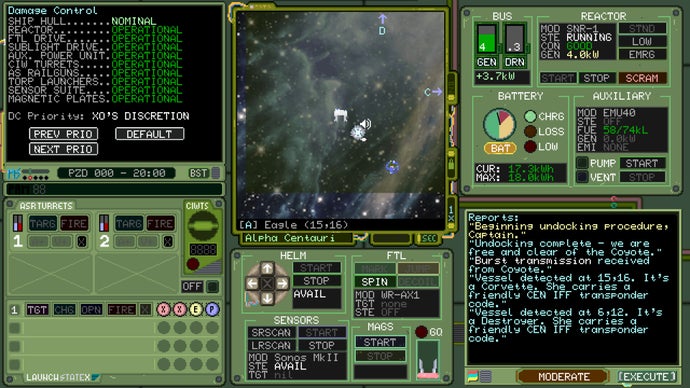
MicroProse's legacy looms large over Deck & Conn, a new indie simulation that resurrects the spirit of Star Trek: The Motion Picture Game, a title released in 1971 when the original television series had barely finished its run. Developer Incandescent Games channels that ancient lineage directly, crafting a starship bridge simulator that demands players manage systems, power distribution, and tactical positioning with methodical precision rather than reflexes.
The core loop mirrors classic MicroProse design philosophy. Players sit in the captain's chair of the USS Enterprise, navigating procedural star systems while distributing power between weapons, shields, engines, and sensors. Every action consumes turns. Activating the auxiliary power unit takes time. Spinning up the reactor drains more time. Charging weapons drains power. This layered resource economy forces constant decision-making, creating tension without combat animations or flashy explosions.
Deck & Conn wears its 1971 inspiration openly. The original Star Trek game on the PDP-10 demanded text commands and abstract strategy, eschewing real-time combat for turn-based tactical thinking. That game vanished into obscurity, overshadowed by later Star Trek titles and the eventual colonization of space games by action-oriented design. Incandescent Games resurrects those principles for a modern audience that craves deep simulation over accessibility.
The question lingers whether this approach resonates with today's simulation audience. Players drawn to deep sims like Kerbal Space Program, Dwarf Fortress, and Cosmoteer expect tremendous complexity paired with systems that reward mastery. They tolerate obscure menus, opaque mechanics, and steep learning curves. However, they also expect emergent storytelling or visible progression. Deck & Conn delivers the former. Whether it delivers the latter remains unclear.
The game's minimalist aesthetic mirrors its mechanical restraint. The bridge display lacks flashy holographic interfaces or Star Trek: The Next Generation's polished interactivity. Players read text prompts, check status readouts, and make decisions based on incomplete information. This creates authentic tension, but also potential accessibility walls. Players must understand power management fundamentals before engaging with tactical scenarios. The game doesn't hold hands.
MicroProse's actual legacy includes Sierra Leone's Pirates! and the X-COM series, titles that balanced complexity with approachability. Deck & Conn leans harder into pure complexity, accepting that broader appeal means compromising on depth. The developer's bet suggests a niche exists for turn-based spaceship management that doesn't require mouse reflexes or real-time pressure.
Star Trek gaming has cycled through countless interpretations over five decades. Starfleet Academy trained pilots through arcade sequences. Star Trek Online delivers MMO action combat. Lower Decks invited casual bridge crew roleplay. Deck & Conn occupies a lonely corner: the pure systems simulator without narrative wrapper or cinematic presentation.
Whether indie audiences embrace this uncompromising vision depends on whether they value elegant mechanical depth over production values. The game releases into a market saturated with streamlined sims and action-first games. For players who survived the 1980s and 1990s gaming landscape, who appreciated Starflight's ambition or MicroProse's unforgiving design philosophy, Deck & Conn offers authentic nostalgia tied to mechanics that actually sustain engagement.