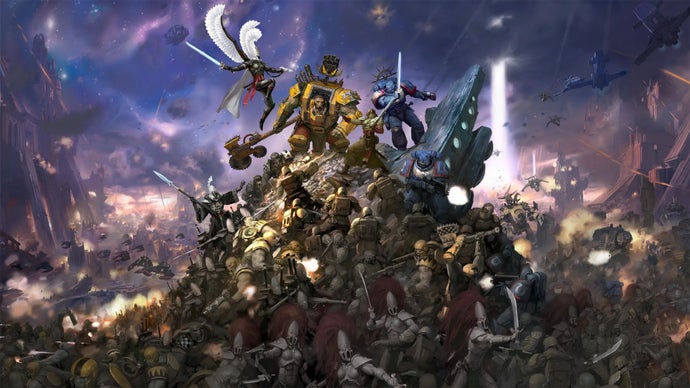
Creative Assembly has committed to a long-term support model for Total War: Warhammer 40,000 rather than developing traditional sequels. The studio plans to expand the game through continuous updates that deepen its existing sandbox instead of fragmenting the playerbase across multiple standalone releases.
This approach marks a departure from the Total War: Warhammer trilogy, which shipped as three separate games between 2016 and 2022. Creative Assembly learned from that structure. Rather than force players to purchase new entries to access fresh factions and content, the developer will fold expansions and major additions into the base game, keeping the community consolidated on a single platform.
The Warhammer 40,000 universe provides the perfect foundation for this live-service evolution. Games Workshop's grimdark sci-fi setting contains dozens of playable factions, countless subfactions, and thousands of named characters across ten thousand years of lore. The galaxy truly is massive. This scope justifies years of post-launch development without requiring a numbered sequel.
Total War: Warhammer 40,000 enters a crowded genre space. Players already engage with Warhammer 40K through Dawn of War III, the older Dawn of War series, Battlesector, and countless tabletop adaptations. Creative Assembly's blend of real-time tactics and turn-based campaign strategy offers something distinct. The Total War formula has proven resilient across historical, fantasy, and hybrid settings. Warhammer 40,000 simply extends that proven template into the far future.
This live-service commitment also reflects broader industry trends. Publishers increasingly view live games as revenue engines that generate continuous monetization through battle passes, cosmetics, and premium content. A single base game updated for five to ten years can generate more lifetime revenue than three sequential $50-60 releases. Players benefit from not repurchasing the core experience, though ongoing purchases become normalized.
The strategy carries risk. A poorly received launch could doom the entire project with no sequel reset available. Creative Assembly cannot rely on "we'll fix it in the sequel" thinking. Every major content drop, balance patch, and gameplay addition must convince players to stay invested in the base game. That pressure breeds either excellence or abandonment.
Release timing remains unconfirmed, but Creative Assembly's public commitment to the sandbox-expansion model signals confidence in the long-term vision. The studio chose this path deliberately rather than defaulting to the trilogy approach. That decision suggests the team believes Total War: Warhammer 40,000 will sustain engagement across multiple factions and playstyles without requiring players to buy separate games.
This commitment also protects the competitive scene. Total War esports remains niche compared to League of Legends or StarCraft, but a unified player base on a single game client eliminates fragmentation that traditionally plagues RTS titles. Everyone plays the same version, watches the same meta evolve, and competes within identical rulesets.
The approach demands active community management and transparent development roadmaps. Players tolerate aggressive monetization in live games when developers clearly communicate upcoming content and balance directions. Creative Assembly's track record with Total War: Warhammer's four-year post-launch support suggests the studio understands these expectations.
Creative Assembly essentially committed to treating Total War: Warhammer 40,000 as infrastructure rather than product. That mindset works only if the foundation launches strong and the developer maintains momentum through regular, compelling updates. The galaxy awaits.