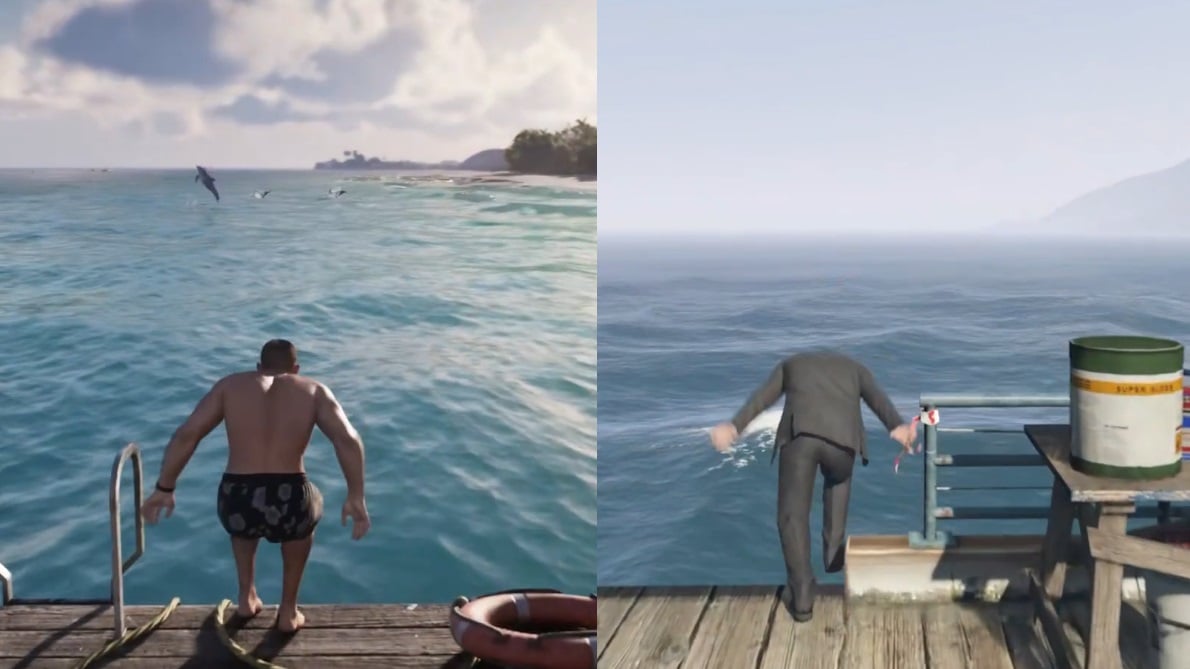
Rockstar Games' Grand Theft Auto 6 has sparked heated debate among fans comparing its visual fidelity to 2013's Grand Theft Auto 5, with many players marveling at the generational leap in graphics quality. The comparison dominates social media and gaming forums, where users dissect trailers and footage to measure just how far the franchise has advanced across current-generation hardware.
The visual improvements run deep. GTA 6 showcases significantly enhanced lighting systems, more detailed character models, and expanded environmental density that transforms Vice City, the game's fictional Miami-inspired setting, into a living, breathing world. Textures appear richer. Draw distances stretch further. NPCs exhibit more nuanced animations and varied behavior patterns. Water reflections render with photorealistic precision. The weather systems integrate dynamic lighting that shifts how the entire world appears throughout in-game time cycles. These upgrades emerge from the substantial technological gap between PS3/Xbox 360 era hardware that powered GTA 5 and the current PS5/Xbox Series X generation.
However, skepticism persists within the community. Some veteran players argue that Rockstar leaned heavily on visual polish rather than fundamental gameplay innovation, questioning whether the improvements constitute genuine evolution or merely aesthetic refinement. This tension reflects broader industry discourse about the difference between graphical advancement and meaningful gameplay design evolution. The studio has maintained relative secrecy around GTA 6's mechanics beyond what trailers reveal, intensifying speculation about whether core systems received comparable overhauls.
The comparison phenomenon extends beyond casual observation. Gaming outlets and YouTube channels dedicated considerable analysis to side-by-side breakdowns, measuring performance metrics, environmental responsiveness, and animation fidelity. Tech reviewers consistently note that GTA 6's engine handles destruction, traffic simulation, and crowd density at scales GTA 5 never attempted. The technical architecture appears fundamentally rebuilt rather than incrementally patched.
Rockstar's development philosophy has always prioritized cinematic presentation and world immersion. GTA 6 amplifies this approach, with motion capture technology capturing more nuanced character performances and dialogue delivery. The facial animation improvements alone represent a substantial leap from GTA 5's dated character models. Lighting design transforms familiar urban environments into spaces that feel architecturally convincing and atmospherically distinct across different neighborhoods.
Fan enthusiasm about visual improvements doesn't automatically translate to universal praise. Some players express concern that visual investment might have constrained innovation in gameplay systems, mission design, or mechanical complexity. Others worry about optimization issues or whether Rockstar's ambitions might create performance compromises across different hardware configurations.
The visual comparison debate ultimately reflects genuine anticipation for GTA 6's October 2025 launch. Whether the game delivers gameplay depth matching its graphical ambition remains an open question that only release and extended playtime will answer. The visual renaissance everyone observes represents the floor, not necessarily the ceiling, of what Rockstar delivered.