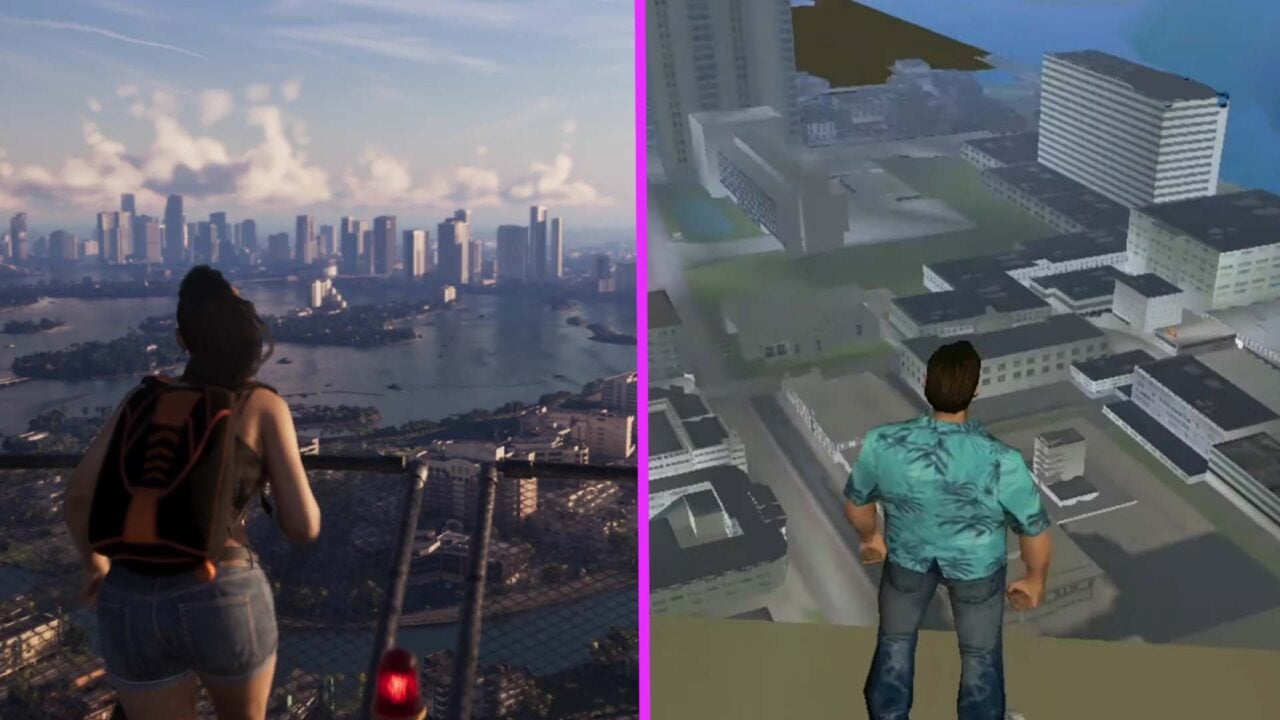
# GTA 6 Visuals Leave Vice City in the Dust: 23 Years of Rockstar's Evolution
Rockstar Games' progression from Grand Theft Auto: Vice City on the PS2 to Grand Theft Auto 6 on the PS5 spans nearly a quarter century of technical innovation. A visual comparison between the 2002 original and the upcoming 2025 sequel reveals the staggering leap in graphical capability, world design, and environmental detail that defines modern open-world development.
Vice City launched as a technical marvel for its era, delivering pixelated neon-soaked Miami with chunky character models and flat textures. The PS2 hardware pushed blocky architecture, distant pop-in effects, and simplified animations that players nonetheless found immersive. Pedestrians moved in stilted patterns. Water reflected nothing. Draw distances measured in meters. The game ran at roughly 30 frames per second with visible frame rate dips during action sequences.
GTA 6 operates on an entirely different computational plane. The PS5 version renders photorealistic environments with ray-traced lighting, dynamic weather systems, and vegetation that responds to wind and movement. Character models now display individual strand hair simulation, realistic skin pores, and clothing that tears and dirties during combat. Facial animations capture micro-expressions. The world loads seamlessly without loading screens or noticeable pop-in at distances that would have been impossible on PS2 hardware.
Environmental storytelling expanded dramatically. Vice City featured painted billboards and flat storefronts. GTA 6's Leonida region displays intricate interior spaces visible through windows, NPCs performing daily routines with branching behavior patterns, and interactive environmental details that respond to player input. The draw distance stretches across entire districts with no culling. Water physics simulate currents, waves, and submersion interaction. Particle effects from explosions, weather, and environmental hazards spawn thousands of individual elements.
This visual gulf reflects the technical specifications separating generations. The PS2 operated with 32 megabytes of RAM and a Graphics Synthesizer capable of rendering roughly 66 million polygons per second. The PS5 delivers 16 gigabytes of GDDR6 RAM and a GPU processing over 10 teraflops. Storage jumped from DVD's 4.7-gigabyte capacity to Blu-ray's 50 gigabytes and then to the PS5's internal SSD supporting game sizes exceeding 100 gigabytes.
Rockstar's design philosophy evolved alongside hardware capabilities. Vice City's map covered roughly 127 square kilometers but featured sparse interiors and limited vertical exploration. GTA 6's Leonida expands the playable area while densifying every inch with explorable locations, hidden interiors, and layered architecture that encourages environmental discovery. The studio invested seven years in development, utilizing photogrammetry to capture real-world Miami locations and procedural systems to populate districts with contextually appropriate environmental assets.
The comparison underscores how open-world design matured during this period. Vice City represented the ceiling for PS2-era ambition. GTA 6 demonstrates what happens when developers leverage modern hardware constraints alongside nearly quarter-century of iterative design lessons. Rockstar refined mission pacing, player agency mechanics, character writing, and environmental reactivity across four numbered entries and multiple spin-offs.
This generational leap extends beyond graphics. GTA 6 reportedly implements advanced AI pathfinding, dynamic dialogue systems adjusting to player appearance and actions, and persistent world changes reflecting player decisions. Such systems required computational resources Vice City couldn't theoretically accommodate.
The visual comparison serves as industry documentation. It proves that despite hardware plateauing relative to early console generations, developers continue extracting meaningful graphical improvements through software optimization and design discipline.