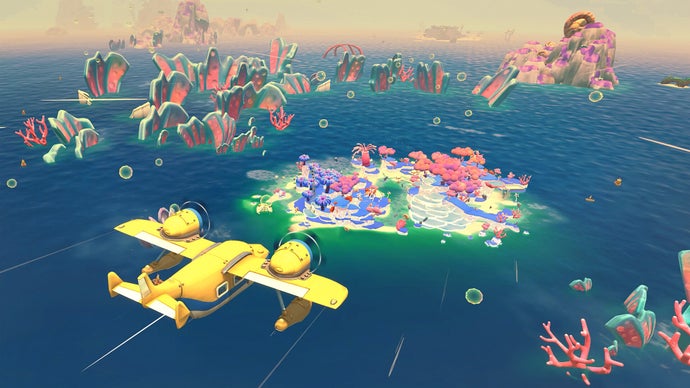
Lou's Lagoon launched today as a craft-focused exploration game built around piloting a customizable seaplane through a tropical archipelago. The indie title invites players to search for a missing uncle while helping rebuild island communities, blending narrative discovery with relaxed island-hopping gameplay.
The seaplane serves as the game's central hook and primary vehicle for exploration. Players can modify and personalize their aircraft to suit their playstyle, with the design philosophy clearly drawing inspiration from Hayao Miyazaki's Porco Rosso. That influence extends beyond aesthetics into the game's overall tone, which emphasizes adventure and whimsy over combat or time pressure.
Lou's Lagoon positions itself within the broader indie exploration game space, a category that has grown steadily since titles like A Short Hike and Spiritfarer found audiences hungry for games focused on exploration, interaction, and narrative over mechanical complexity. The emphasis on archipelago traversal and community rebuilding suggests the developers incorporated light management mechanics alongside pure discovery gameplay.
The missing uncle premise frames the narrative journey, but Lou's Lagoon appears to structure itself around player agency and curiosity. Rather than forcing a linear progression, the game encourages exploration and rewards players for discovering islands, characters, and side activities at their own pace. This approach aligns with current indie trends favoring player-driven narratives over scripted sequences.
The seaplane customization system likely serves dual purposes. Mechanically, upgrades probably improve the aircraft's range, speed, or storage capacity, enabling access to new areas and resources. Thematically, customization builds attachment to the vehicle itself, transforming it from a mere transportation tool into a character players actively care about. The Porco Rosso reference reinforces this emotional connection, as that film's protagonist forms a deep bond with his aircraft.
Crafting mechanics appear central to the loop. The community rebuilding element suggests players gather resources across islands and use them to restore structures or services, unlocking new interactions with NPCs. This creates a feedback loop where exploration yields materials, crafting creates infrastructure, and new infrastructure enables further exploration or story progression.
Lou's Lagoon targets players seeking slower-paced experiences and complete creative control over their gaming session. The lack of combat, enemies, or failure states makes it accessible to players traditionally underserved by the gaming industry, including those seeking relaxation-focused gameplay.
The game's release on PC (via Steam) places it within the indie-friendly platform ecosystem where discovery games thrive. Pricing and exact feature set will determine whether Lou's Lagoon captures the audience that sustained similar titles, though the distinctive seaplane hook and Miyazaki-adjacent aesthetic give it identifiable branding in a crowded category.
The archipelago setting and customization focus distinguish Lou's Lagoon from direct competitors like A Short Hike, which centered on a single mountain. Multiple islands create opportunities for distinct visual themes, environmental storytelling, and diverse character interactions that can sustain engagement across a 5-15 hour campaign, depending on content depth.
Lou's Lagoon arrives in an indie marketplace increasingly receptive to non-violent, exploration-centric design. Its success will likely hinge on execution quality, writing depth, and whether the seaplane mechanics feel genuinely fun rather than gimmicky. The title joins an expanding library of comfort games designed for players prioritizing exploration and character connection over challenge and progression.