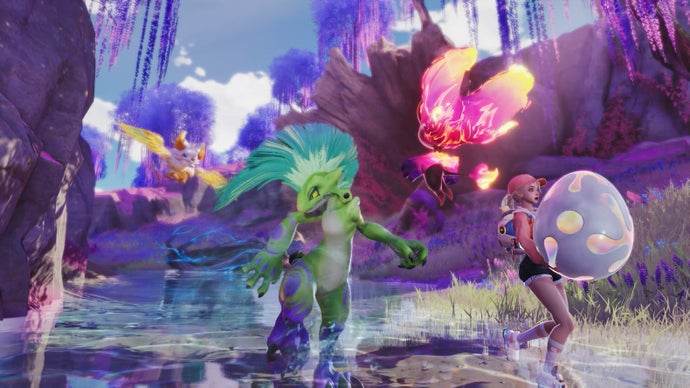
Nvidia's ACE (Avatar Cloud Engine) technology is expanding beyond PUBG: Battlegrounds into the creature-collecting RPG space. The company announced that Aniimo, a monster-catching game positioning itself as a spiritual successor to Pokemon, will integrate Nvidia's generative AI tech to create interactive NPC creatures that players can converse with directly.
ACE powers PUBG's recent AI-driven teammate system, which generates intelligent companion bots capable of tactical decision-making and natural dialogue. That same foundation now moves into the creature-collection genre, where Aniimo players will interact with their caught creatures through conversational AI rather than traditional menu-based systems. The feature launches in early 2025.
Aniimo occupies a specific market niche. It operates as a free-to-play creature collector that avoids Pokemon's established IP while borrowing the core loop of capture, training, and battling fantastical creatures. By layering Nvidia's generative AI onto creature interactions, Aniimo differentiates itself through dialogue systems that procedurally generate responses based on player input. This creates the illusion of genuine creature personality rather than scripted responses.
The broader context matters here. Generative AI integration in games remains in early adoption phase. Most implementations either feel superficial or spark controversy around development ethics. PUBG's AI teammates represented a watershed moment, demonstrating practical combat applications where AI bots perform genuinely useful functions alongside human players. They supplement rather than replace player agency. Aniimo takes a different approach, using AI for flavor and immersion rather than mechanical necessity.
Nvidia's ACE technology specifically targets this market segment. The platform runs on Nvidia's cloud infrastructure and relies on large language models to generate contextually appropriate NPC responses. Developers feed the system basic creature personalities and traits, then ACE generates unique dialogue on the fly. This reduces development workload compared to traditional voice acting or hand-scripted branching dialogue trees. It also creates scalability problems that Nvidia must solve, since thousands of concurrent players generating simultaneous queries could overwhelm server infrastructure.
For Aniimo's developers, the appeal is clear. Smaller studios typically cannot afford the production overhead of full voice acting or extensive narrative scripting. Nvidia's tech democratizes that capability. Whether players want AI-generated creature dialogue remains untested. Some players embrace emergent conversations and dynamic responses. Others find generative text uncanny or prefer authored narrative experiences.
The timing connects to broader GPU market dynamics. Nvidia dominates AI infrastructure spending. ACE represents a beachhead into game development, creating dependency on Nvidia's cloud services and hardware. Every game using ACE generates recurring revenue for Nvidia beyond GPU sales. This incentivizes aggressive marketing to indie developers seeking affordable NPC systems.
Aniimo launching with ACE integration positions it as an early experiment in player acceptance of generative AI companions. Success here validates the technology for future creature-collecting games and potentially other genres requiring extensive NPC interactions. Failure would suggest players prefer traditional narrative design despite increased costs.
The feature set releasing in early 2025 remains unspecified. Aniimo has not detailed conversation depth, creature personality variation, or whether dialogue impacts gameplay mechanics. These decisions shape whether ACE feels like genuine character interaction or hollow novelty. The creature-collection audience skews younger, where player perception of AI versus authentic creativity carries weight for long-term engagement and retention.