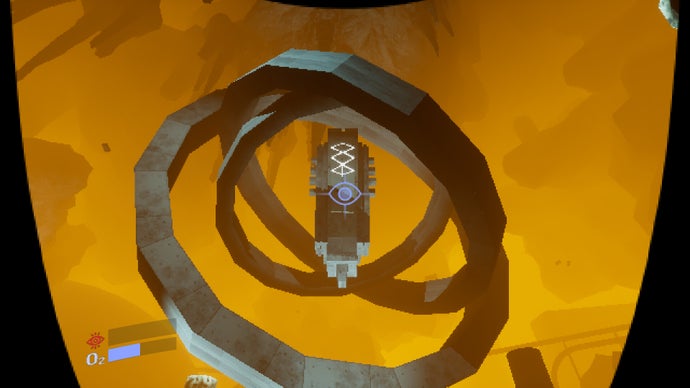
Hello Andromeda's Sarco takes the observer effect and weaponizes it into a survival horror premise that demands constant vigilance. The game traps players inside a gutted scientific research facility where a cosmic entity lies imprisoned within a sarcophagus. The catch: the creature only remains contained while you watch it. The moment your gaze breaks, the sarcophagus lid slides open. Stop looking, and the apocalypse advances. Look away too long, and reality fractures.
The no-saves design amplifies the tension. Death sends you back to the start with no checkpoints, no mercy. This isn't a game that rewards exploration through traditional means. You navigate the abandoned base while maintaining optical contact with an entity you cannot afford to observe too closely for psychological reasons, yet must observe constantly for survival. The contradiction sits at the heart of the design, a Lovecraftian twist on the Weeping Angels mechanic popularized by Doctor Who.
The premise borrows from quantum mechanics. Observation collapses probability waves. In Sarco, observation literally maintains the fabric of normalcy. It's a horror concept built on scientific abstraction, appropriate for a research facility setting. The developers layer exploration onto this core constraint. You have to map the base, solve puzzles, gather resources, all while keeping an eye on something that exists in superposition. The moment you look away to examine an object, check your inventory, or squeeze through a narrow passage, the sarcophagus begins to open. Time spent without looking at the entity creates a tension meter that climbs toward failure.
This forces players into impossible decisions. Do you explore that promising corridor, knowing the cosmic prisoner gains freedom while you're distracted? Do you rush back to maintain observation and miss crucial resources? The game weaponizes player instinct. Natural curiosity becomes liability. Environmental storytelling and base exploration compete directly with the survival objective. Sarco doesn't let you have both.
The no-saves system removes safety nets entirely. Failed runs don't just reset progress. They reset your understanding of the space. Each attempt to explore becomes a genuine gamble. You learn the layout through death, through repeated failure, through the slow realization of what the game actually requires from you. This recalls roguelike design philosophy, but Sarco applies it to a single-location horror scenario where knowledge accumulates but frustration compounds.
Hello Andromeda builds Sarco around a single mechanic stretched to its breaking point. That's the indie horror approach at its best. The game doesn't need multiple enemy types or complex combat. It needs tension, a clear rule, and the willingness to make that rule hurt the player. The cosmic entity never becomes a conventional antagonist. It remains a passive obstacle, a consequence of inattention. Your real enemy is your own need to explore, to understand, to look elsewhere.
The premise also hooks into cosmic horror tradition. The "Black Goat of the Woods with a Thousand Young" references H.P. Lovecraft directly. The game understands that the best Lovecraft adaptations don't center on monster design. They center on incomprehension, on the human inability to perceive and process the truly alien. Sarco makes that incomprehension mechanical. You cannot stare at the creature without psychological damage, yet your survival depends on constant observation. The game becomes a thesis on the price of knowledge.