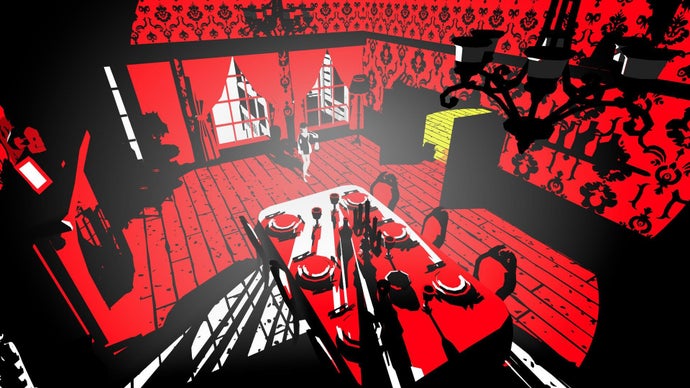
NECHROMIA arrives as a deliberate stylistic departure from the PS1 horror revival trend that has dominated indie development over the past five years. While games like Resident Evil and Silent Hill remakes continue to define retro-horror aesthetics, NECHROMIA carves out distinct visual territory through chromatic aberration and high-contrast design principles.
The game positions itself within a castle constructed from fragmented memories, a narrative conceit that mirrors its technical approach to visual distortion. Rather than chasing polygon counts or faithful recreation of early-2000s graphics, NECHROMIA leans into optical distortion effects typically associated with analog video degradation or lens imperfection. This chromatic aberration technique separates color channels to create deliberate visual artifacts, transforming what might feel like technical limitation into intentional aesthetic choice.
The survival horror space has expanded considerably beyond literal PS1 homages. 2024's Sorry We're Closed demonstrated that contemporary horror design could embrace queer identity and thematic boldness while maintaining retro visual language. NECHROMIA follows this trajectory but charts a different formal path. Where Sorry We're Closed refined early hardware aesthetics, NECHROMIA weaponizes optical distortion as both atmosphere and gameplay element.
High-contrast visual design serves dual functions in survival horror. It enhances dread by eliminating comfortable mid-tones where players typically orient themselves spatially. Deep blacks and blown-out whites create visual stress. Simultaneously, chromatic aberration introduces perceptual uncertainty. Players cannot fully trust their visual information. This design philosophy acknowledges that horror operates through discomfort as much as threat.
The castle-as-memory concept carries weight beyond mere setting dressing. Procedurally generated or memory-based level design permits illogical architecture that pure realism cannot justify. Spaces shift. Doors lead to contradictory locations. Perspective warps. All of these become plausible within a location built from psychological rather than physical substrate.
NECHROMIA targets PC as its primary platform, situating it within the indie horror ecosystem where experimental aesthetics find audiences more readily than within mainstream console or AAA publishing. This positioning allows developer freedom to prioritize artistic coherence over market-tested formulas. The indie survival horror category has proven commercially viable since Amnesia's 2010 release, but it now accommodates multiple competing visual languages simultaneously.
The broader survival horror landscape benefits from this aesthetic pluralism. Player fatigue with pixel-art and low-polygon approximations creates demand for visual innovation within the retro-horror umbrella. NECHROMIA's chromatic aberration approach addresses this appetite directly. It preserves the psychological directness of early horror games while introducing formal techniques unavailable on original hardware.
Memory as a structuring principle opens narrative possibilities beyond typical survival horror storytelling. Rather than surviving against external threats, players navigate a landscape that refuses stable meaning. Whose memories comprise the castle? How do those memories shape threat and escape? These questions position NECHROMIA as closer to narrative-driven horror than action-focused survival titles.
The high-contrast aesthetic also carries practical production advantages for small teams. Complex lighting systems demand technical resources. Deliberate visual degradation and color separation require artistic discipline rather than rendering horsepower. This approach democratizes horror game development, permitting smaller studios to compete aesthetically with better-funded competitors.
NECHROMIA represents the maturation of PS1-era revival gaming beyond superficial nostalgia. It takes the technical and emotional vocabulary of early survival horror and applies contemporary artistic techniques to create something genuinely divergent from its influences.