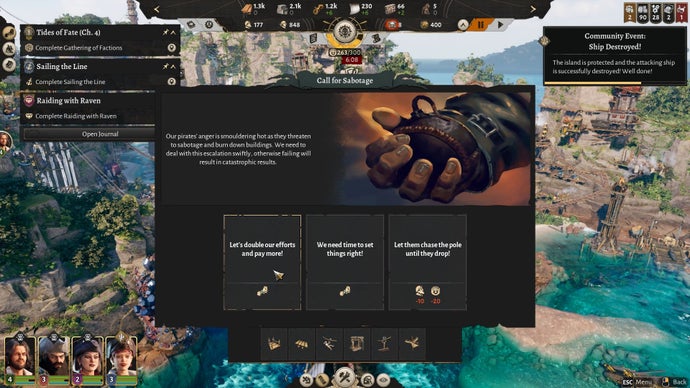
Limbic Entertainment's Corsair Cove strips the romance from piracy and replaces it with something far more revealing: the brutal mathematics of supply chain management. This city builder, published by Hooded Horse, plants players on a tropical island tasked with keeping a population of demanding pirates satisfied through relentless logistics work rather than sword swinging or treasure hunting.
The game's core premise inverts player expectations. Instead of roleplaying as a swashbuckling captain commanding raids, you manage infrastructure on an island surrounded by Spanish galleons, pirate hunters, and krakens. Your job becomes feeding, clothing, and equipping a population of increasingly finicky buccaneers who evolve from wanting basic survival necessities into demanding luxury goods.
Early game demands prove straightforward. Pirates need food, drink, and shelter to function. Production chains operate simply. But progression exposes the genre's defining tension. As population morale climbs, wants escalate dramatically. Eyepatches become mandatory. Leather boots follow. Turtle soup appears on demand. Each new luxury requires dedicated production pipelines, resource sourcing, and distribution networks. Miss production targets and your pirate workforce deteriorates into an angry mob.
This mirrors the design philosophy perfected by city builders like Cities: Skylines and Frostpunk. Limbic Entertainment borrows the formula established by management sims where infrastructure failure cascades into systemic collapse. Pirates don't simply accept shortages. They voice displeasure directly, creating visible feedback loops between player decisions and population morale. The headline reveals the core experience. Players struggle to manufacture eyepatches quickly enough, generating a comically frustrating scenario where a cosmetic item becomes a bottleneck threatening the entire operation.
Hooded Horse has carved a publishing niche focused on ambitious strategy and management games. The label released Crusader Kings III expansions, Prison Architect, and Manor Lords. Corsair Cove fits squarely in this catalog, targeting players who derive satisfaction from systems optimization rather than action sequences.
The game launches into early access, meaning Limbic Entertainment continues development based on player feedback. Early access city builders historically shape significantly during their community testing phases. Players will identify production bottlenecks, suggest balance adjustments, and reveal unintended strategies that developers then refine.
Corsair Cove arrives during an interesting market moment. City builder interest resurged throughout the last five years, driven by Cities: Skylines 2, Manor Lords' early access success, and smaller titles like Timberborn. Players increasingly seek complex management experiences where failure stems from poor planning rather than reflexes. Adding pirate theming and island management distinguishes Corsair Cove from medieval and urban-focused competitors, though the core loop remains fundamentally similar.
The game targets PC via Steam early access. Console releases remain unconfirmed. PC platforms have dominated city builder distribution since the genre requires precise interface controls and typically benefits from mouse and keyboard input.
Corsair Cove reveals something obvious yet often forgotten. Pirates needed feeding. Empires required administration. Legends required logistics. The game embraces this unglamorous truth and makes it entertaining through layer upon layer of production systems where failure becomes personal when your pirate crew openly despises you for manufacturing delays.