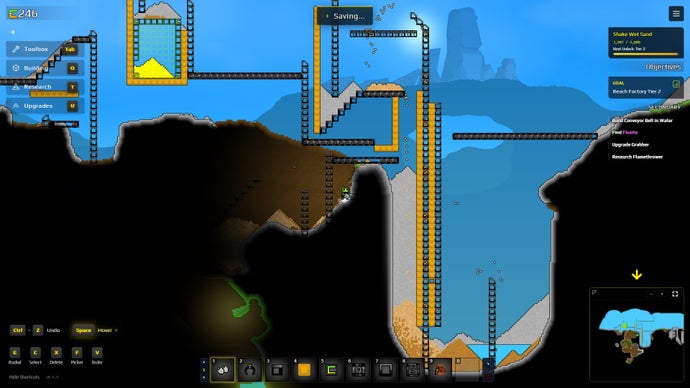
Sandustry, the new factory simulation from indie studio Lantto Games and publisher Hooded Horse, marks a turning point for the genre. After years of factory builders that stumble on core systems, Sandustry executes across the board.
The game positions itself as a "spelunking factory builder," blending underground exploration with resource extraction and production chains. Players descend into mines, map out layouts, and construct processing facilities to refine raw materials into finished goods. The twist lies in the vertical dimension. Rather than spreading horizontally across terrain, players build downward, managing depth, geology, and the logistics of moving materials through multi-level operations.
What separates Sandustry from rivals like Factorio or Satisfactory is its attention to pacing and feedback loops. The early game teaches systems gradually without overwhelming players with infinite customization options upfront. Factory builders often paralyze newcomers with too many production paths immediately available. Sandustry gates progression smartly, introducing new production chains as players unlock deeper mining zones. This creates natural story beats within a sandbox framework.
The UI respects player time. Conveyor placement, splitter configuration, and production line management feel responsive rather than fiddly. Camera controls snap to useful angles automatically. Menu navigation avoids the busywork that plagues competitors. These small polish touches compound. Players spend more time building and less time fighting interfaces.
Production chains themselves carry weight. Unlike some factory games where optimization becomes purely mathematical, Sandustry's systems feel grounded in logic. A sand processing line requires washing equipment, settling tanks, and drying stages that mirror real industrial processes. This grounding makes problem-solving feel earned rather than arbitrary.
The game also nails difficulty scaling. Players can toggle production quotas, market prices, and resource scarcity independently. This lets veterans create brutal supply-chain puzzles while newcomers learn fundamentals without panic. No single "correct" playstyle exists, and the game rewards both min-maxed efficiency and chaotic experimentation equally.
Performance matters for factory games. Sandustry runs smoothly even with hundreds of conveyor segments and active production facilities. The rendering engine doesn't bottleneck creativity like some competitors do. Larger factories don't devolve into stuttering management nightmares on mid-range hardware.
Hooded Horse's publishing muscle helped here. The studio known for Crusader Kings III and Victoria 3 brought professional QA and optimization resources to Lantto's concept. It shows. The 1.0 launch contained none of the progression-breaking bugs or balance disasters that plagued early access factory games in recent years.
Aesthetically, Sandustry leans into industrial beauty. Sand dunes and rock formations transition between mining levels with visual coherence. Factories glow at night. Conveyor systems form satisfying geometric patterns. The soundtrack reinforces atmosphere without becoming distracting. Visual design serves gameplay without sacrificing atmosphere.
This matters because factory games live or die on hundreds of hours of engagement. Players stare at production lines for dozens of sessions. Ugly interfaces, grating audio, or repetitive visuals break immersion faster than broken mechanics. Sandustry avoids these traps.
The indie scene produces factory builders regularly. Most disappear within months. Sandustry has the systems depth, production values, and design discipline to sustain interest long-term. It competes directly with established franchises by executing better on fundamentals rather than attempting innovation for its own sake.