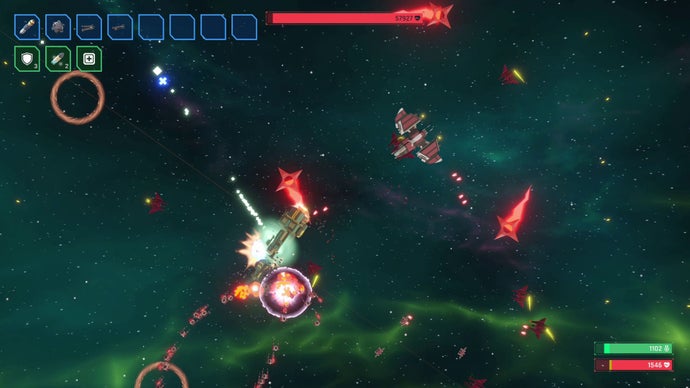
Vampire Survivors shaped the bullet heaven genre, but Seven Suns of Orion exposes what the Poncle hit left behind: railguns and Newtonian physics that fundamentally change how players approach survival gameplay.
Seven Suns of Orion launches as a spacefaring answer to the roguelike wave shooter formula. The game strips away Vampire Survivors' gothic fantasy wrapper and replaces it with a sci-fi setting where players pilot a spacecraft through swarms of enemies. But the real differentiator isn't the setting. It's the semi-Newtonian physics engine that governs movement and combat.
Unlike Vampire Survivors, where character movement feels floaty and weightless, Seven Suns of Orion grounds its mechanics in momentum and inertia. Your ship actually moves through space with physics-based momentum. This changes everything about positioning, weapon trajectory, and tactical decision-making. You can't instantly halt or change direction. Every action has consequences. Every dodge carries weight. The physics layer forces players to plan movement several frames ahead, creating a tension loop that Vampire Survivors resolves through pure chaos and screen-filling projectiles.
The railgun is the symbolic centerpiece here. Vampire Survivors leans heavily on rapid-fire, spread-based weapons that fill the screen with projectiles. Railguns demand precision. They fire single, devastating beams that require line-of-sight tracking and positioning. This weapon class forces an entirely different playstyle than Vampire Survivors' spray-and-pray approach. Positioning matters in a new way. Distance calculations matter. Lead shots matter.
Vampire Survivors built a cultural phenomenon by simplifying the roguelike formula into its purest form: survive waves, pick up power-ups, watch numbers go up. Poncle's design philosophy embraced accessibility and visual spectacle over mechanical depth. The game intentionally eschewed complex physics, frame-perfect inputs, or movement nuance. This democratized the genre and made it accessible to players who struggled with traditional action games.
But that accessibility came with trade-offs. Vampire Survivors' movement becomes predictable once you understand the flow. Spacing feels arbitrary rather than earned. The skill ceiling flattens quickly because physics don't punish poor positioning hard enough. You can autopilot through much of the experience once you've leveled up enough.
Seven Suns of Orion targets players who mastered Vampire Survivors and crave mechanical depth. The semi-Newtonian physics create emergent situations that feel distinct run to run. Your ship's inertia makes certain weapon combinations work better than others. Railguns reward player skill in ways that automatic weapons cannot. The physics layer adds a skill expression ceiling that extends the game's longevity.
This doesn't make Seven Suns of Orion better than Vampire Survivors. Both games serve different audiences. Vampire Survivors remains the more accessible entry point and the superior power fantasy. Seven Suns of Orion positions itself as the mechanical evolution for players who've exhausted what Vampire Survivors offers.
The bullet heaven genre now has two clear branches. One prioritizes accessibility, visual chaos, and the dopamine rush of exponential scaling. The other demands mechanical literacy and rewards precision. Seven Suns of Orion's railguns and physics engine represent the genre's maturing into a space where both player types can find exactly what they want.