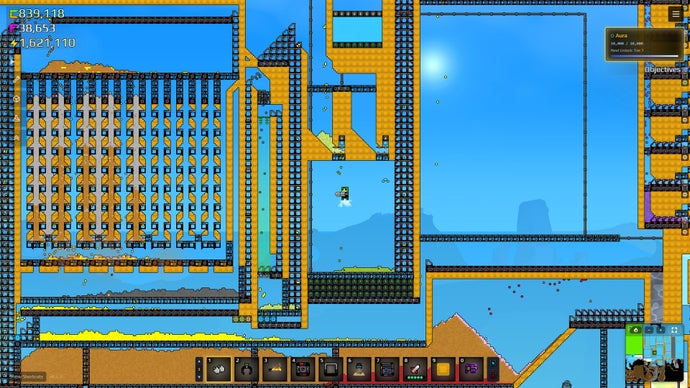
Sandustry launched into early access this week as a factory-building game with a literal twist. Every pixel on screen serves as a buildable resource, transforming the entire game world into raw material for construction and production.
The game arrives amid a curious wave of sand-themed titles. Sandcastle, a physics-based sandbox builder focused on literal sand castles, dropped a demo earlier this month. Sandustry takes the sand concept in a completely different direction. Rather than architectural play, it centers on constructing and managing factories using sand and other pixel-based resources. The game layers in exploration and narrative elements around discovering an ancient civilization's secrets, adding story structure beneath the mechanical sandbox.
This resource-as-pixel approach creates a novel design challenge. Traditional factory games like Factorio or Satisfactory require players to gather resources scattered across a map or generated through production chains. Sandustry eliminates that separation. The environment itself becomes harvestable material. Building that conveyor belt doesn't require finding iron ore somewhere else. The pixels composing the ground, walls, or terrain can be repurposed directly into machinery. This creates tighter feedback loops and forces different strategic thinking about spatial management and terrain manipulation.
The pixel-as-resource mechanic also carries visual clarity benefits. Players always see exactly what they have to work with. No fog of war hiding resources. No abstract inventories disconnected from the world. Everything buildable lives on screen, making the visual language the primary interface for understanding availability and constraint.
Early access status means Sandustry remains under active development. The core factory-building loop exists, but features will expand, balance will shift, and performance will improve before the full launch. This positioning lets the developer gather player feedback on whether the pixel-harvesting concept actually delivers engaging gameplay or becomes a gimmick that frustrates more than it innovates.
The factory-building genre has exploded in recent years, extending well beyond Factorio's dominance. Satisfactory brought the genre into first-person 3D space. Dyson Sphere Program scaled production chains to astronomical proportions. Spiritfarer and A Space for the Unbound proved the genre could merge with narrative and emotion. Sandustry's pixel mechanic represents another vector of experimentation, testing whether making the environment itself harvestable creates fresh strategic depth.
The timing capitalizes on genre momentum. Players actively hunt for new production-chain experiences. Early access also reduces risk for both developer and players. The developer gets real playtime data before committing full resources to completion. Players invest modest sums to shape the final product.
Ancient civilization secrets mentioned in the description hint at progression beyond pure factory optimization. This narrative wrapper could push Sandustry past pure mechanical loops into something with exploratory discovery, story beats, and perhaps multiple playstyle paths through environmental storytelling. That layering typically resonates better with broader audiences than pure sandbox complexity.
Sandustry's success hinges on whether pixel-harvesting creates genuine strategic depth or feels like novelty. The early access period will reveal if the mechanic generates interesting build choices or if it becomes busywork. Factory games live or die on compelling progression and meaningful player decisions. A gimmick alone never sustains engagement. The pixels need to matter beyond their visual presence on screen.