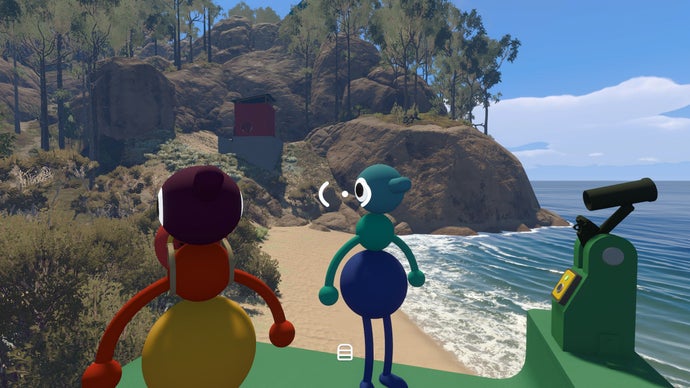
Big Walk strips away the digital safety net that defines modern life. The indie game simulates that primal childhood fear of separation from friends and the overwhelming relief when connection returns.
Developer's concept taps into a deeply relatable anxiety. Players experience the disorientation of being disconnected in an unfamiliar space, forced to navigate without the GPS guidance and constant communication we now treat as essential infrastructure. The game reconstructs the texture of pre-smartphone childhood, when getting lost meant genuine uncertainty and reuniting with your group felt like a genuine victory rather than a text away.
The design deliberately plays with vulnerability. You move through environments without your digital crutches. No map. No notifications. No ability to instantly coordinate with companions. Instead, Big Walk demands observation, memory, and intuitive navigation. The emotional payoff hits when you finally spot a familiar face or landmark that reorients you toward your group.
This mechanic speaks to a generational shift in how we experience public spaces and social bonds. For players who grew up glued to smartphones, losing that connection creates genuine unease. For older players, Big Walk resurrects the ambient anxiety of childhood independence before mobile phones neutralized the risk.
The game arrives as players increasingly question their relationship with always-on connectivity. Big Walk doesn't lecture about digital dependency. Instead, it embodies the feeling, letting players inhabit the strange liminal space between isolation and reunion that older generations knew intimately.
Indie developers continue finding emotional resonance in experiences most AAA studios would dismiss as low-stakes. Big Walk proves that a simple concept executed with psychological precision can hit harder than blockbuster spectacle. The game understands something fundamental about human connection and the comfort we derive from simply knowing how to reach each other.