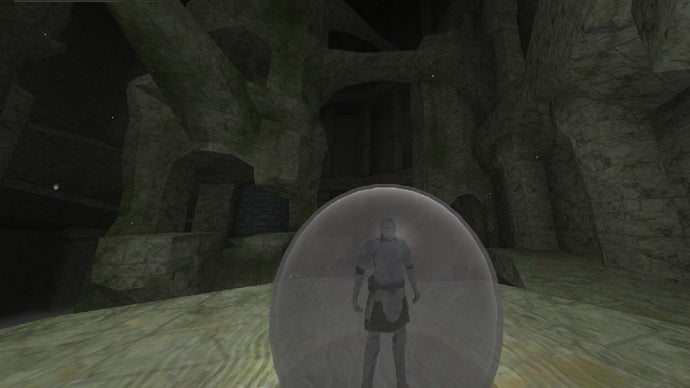
Marble Souls launches this year with a deceptively simple premise. The indie game traps a Dark Souls-style character inside a physics-driven marble and makes rolling the central mechanic rather than an evasion afterthought. Players navigate a Dark Soulsy world collecting lost souls while managing momentum and gravity.
The concept exploits a genuine quirk of FromSoftware's design philosophy. Dark Souls combat rewards constant rolling, turning the dodge into an obsessive habit. Marble Souls weaponizes this reality by removing the character model entirely and replacing it with a ball governed by actual physics. The protagonist no longer rolls to avoid attacks. The rolling is survival itself.
This design shift forces different thinking about level design, enemy placement, and combat spacing. A marble cannot block or parry. It cannot strafe with precision. Instead, players must use momentum, terrain, and physics to navigate encounters and solve environmental puzzles. The Dark Souls aesthetic remains intact—the world looks appropriately gothic and oppressive—but movement operates under completely different rules.
The game joins a growing subset of indie projects that remix established genre conventions through mechanical constraint. Similar to how A Space for the Unbound recontextualized adventure game storytelling or how Baba Is You deconstructed puzzle logic, Marble Souls takes Dark Souls' movement language and rebuilds the entire game around it.
Physics-driven platformers and marble games have their own pedigree dating back decades. Marble Madness defined the genre in 1984. Monkey Ball and subsequent physics-based games proved the concept could support complex level design. Marble Souls aims to fuse that mechanical heritage with Dark Souls' atmosphere, boss design philosophy, and soul-collecting progression systems.
The visual presentation appears solid based on available footage. The marble reflects its environment. Lighting casts properly. The dark world