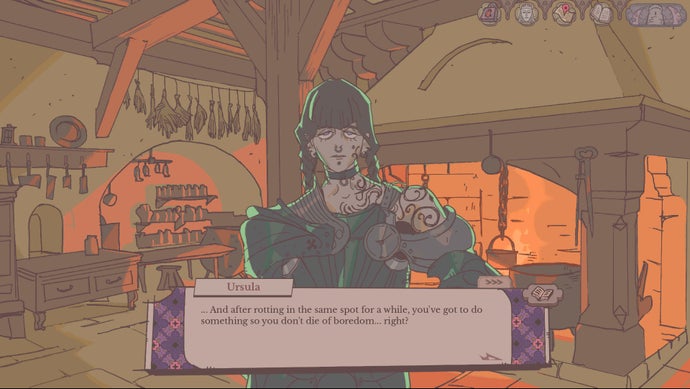
Wild Wits Games' Sovereign Tower positions itself as a turn-based Round Table management RPG where players recruit and command fantasy knights on quests across a fallen kingdom. The game leans into character-driven storytelling, offering recruitable knights like Ursula, a shrewd arcane specialist suited for missions involving grimoires and peculiar encounters like sentient cheese wheels.
The core loop centers on managing a roster of knights with distinct personalities and abilities, sending them into turn-based combat scenarios while balancing resource management and narrative progression. Sovereign Tower combines tactical gameplay with the recruitment and development mechanics familiar to strategy RPGs, though its focus on character personality and faction management distinguishes it from standard dungeon crawlers.
The reviewer appreciates the character design and knight roster depth, praising the fantasy setting's quirky tone and the appeal of commanding memorable personalities. The recruitment system appears robust, offering varied knight archetypes with distinct playstyles and narrative hooks that keep individual party members feeling valuable rather than interchangeable.
However, the time travel element that threads through Sovereign Tower's narrative fails to land consistently. Rather than enhancing the campaign structure or creating meaningful strategic layers, the time mechanics feel tacked on or confusing in execution. The reviewer expresses skepticism about how effectively these temporal mechanics integrate with the otherwise engaging turn-based tactics and character management systems.
Despite this narrative shortcoming, Sovereign Tower maintains appeal for players seeking character-focused tactical RPGs that prioritize personality over purely mechanical depth. The game's strength lies in its cast of weird, oddly charming knights and the satisfaction of assembling and leveling a roster that genuinely feels distinct. For those patient with narrative quirks and interested in management-heavy RPGs, the foundation here exists. The time travel inclusion represents a misstep that doesn't derail the experience but does prevent it from reaching its full potential as a standout indie RPG