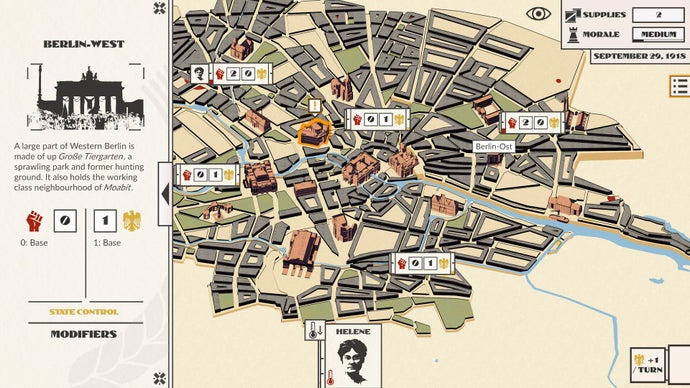
Red Echoes: Berlin positions itself as a narrative strategy game centered on the German November Revolution of 1918-1919. Developer Pixel Trap crafts a turn-based experience that mirrors the political intrigue and moral complexity found in Suzerain, the indie hit that redefined how strategy games handle storytelling.
The game follows three distinct protagonists from different social backgrounds as they navigate the final collapse of the Kaiser's regime during World War 1's closing months. Players deploy subversives across a historically inspired Berlin map, leveraging character abilities to challenge state apparatus while encountering historical figures like Karl Liebknecht and Rosa Luxemburg. The visual design draws from Weimar-era graphic aesthetics, grounding the experience in period authenticity.
Red Echoes: Berlin arrives at a moment when players increasingly demand ideological substance from strategy titles. Suzerain demonstrated that political simulation can drive engagement through meaningful choice architecture and character-driven narrative. This Berlin project extends that template into a historical context where every decision carries weight. The November Revolution itself remains underrepresented in gaming, making this exploration of radical leftist resistance genuinely novel.
The three-chapter structure suggests developers plan meaningful narrative progression. Rather than abstract mechanical optimization, Red Echoes appears to prioritize the human dimensions of revolution. How players navigate class tensions, ideological splits, and state repression will likely determine outcomes across multiple playthroughs.
Turn-based strategy on PC has seen robust indie development. Red Echoes: Berlin competes alongside titles like Wildermyth and Chained Echoes, but its historical specificity and political focus set it apart. The Weimar graphic design choice suggests developers understand their audience values presentation matching substance.
Success depends on execution. Strong narrative writing and meaningful mechanical consequences for player choices would cement this as a standout indie strategy release. Weak writing or arbitrary outcomes