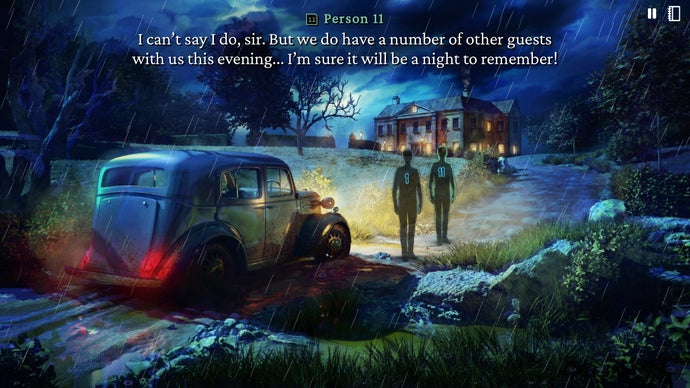
The Incident at Galley House delivers a smartly designed deduction puzzle wrapped in 1930s noir atmosphere. The game centers on a peculiar mechanical device that functions as an investigative tool. Players manipulate switches, dials, and selectors to deduce which suspect committed a crime, selecting from portraits arranged by gender and appearance. The interface harks back to Guess Who but with substantially more complexity and thematic coherence.
Developer Darby McDevitt crafted a game that respects player intelligence. The deduction logic remains sound throughout, and the period setting enhances immersion. Each puzzle forces genuine reasoning rather than random clicking. The mechanical presentation transforms what could have been a dry logic exercise into something tactile and engaging.
However, The Incident at Galley House runs headlong into a persistent problem plaguing the deduction genre. The format, no matter how elegant, eventually exhausts its novelty. The core mechanic remains unchanged across puzzles. After several hours, the investigative satisfaction diminishes. Subsequent cases feel like repetition of the same basic steps with different portrait combinations.
This isn't a flaw unique to Galley House. Games like Return of the Obra Dinn and The Case of the Golden Idol struggled with identical pacing issues. Once players internalize the deduction framework, the gameplay loop loses momentum. The game provides no meaningful variation to sustain engagement through its runtime.
The 1930s aesthetic and radio-powered narrative framework add flavor but cannot fully offset mechanical fatigue. Players seeking a singular, well-crafted deduction experience will find exactly that. Those hoping for evolution or escalating complexity within the genre will leave disappointed.
The Incident at Galley House succeeds within narrow parameters. It executes its premise effectively but cannot transcend the inherent limitations of its design space. Deduction games remain niche experiences for players