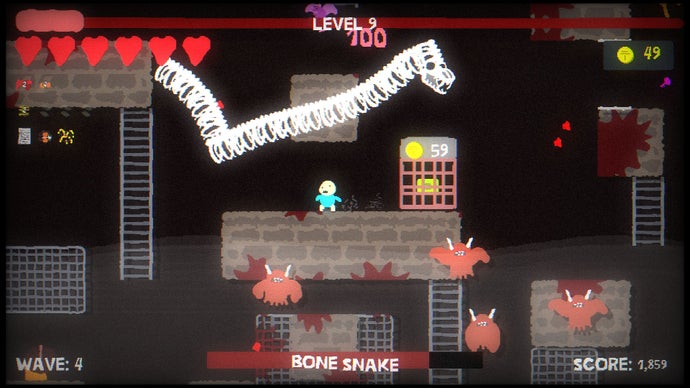
Blood Dungeon merges platformer mechanics with the wave-survival formula that made Vampire Survivors a phenomenon, creating something that works despite its rough presentation. The game tasks players with navigating vertical levels while hordes of enemies swarm in classic roguelike fashion. Unlike pure Survivors clones, Blood Dungeon demands platforming skill alongside the genre's usual chaos management.
The visual design appears deliberately sloppy. Character sprites and environments carry a sketch-like quality that contradicts the precision platforming requires. Yet this aesthetic clash works in the game's favor, giving Blood Dungeon visual identity in a crowded market of Vampire Survivors derivatives. The janky appearance masks solid mechanical foundation.
What separates Blood Dungeon from rivals like Brotato, Deep Rock Galactic Survivors, and Halls of Torment is player agency through movement. Survivors games typically lock characters to arena spaces where weapon upgrades drive progression. Here, jumping and positioning become tactical tools. Platforming sections punctuate survival sequences, forcing players to manage both enemy waves and environmental hazards simultaneously.
The genre has exploded in the past two years. Vampire Survivors spawned dozens of imitators across PC and console platforms. Brotato focused on tower-defense mechanics. Halls of Torment emphasized gothic atmosphere. Deep Rock Galactic Survivors leveraged an existing IP fanbase. Blood Dungeon carves its own lane by demanding the reflexes of a platformer alongside roguelike strategy.
Industry observers note the Survivors subgenre offers accessibility. Games involve minimal storytelling friction and reward short play sessions. Blood Dungeon maintains this appeal while adding mechanical depth. Players seeking pure Survivors simplicity have options. Those wanting platforming complexity now have Blood Dungeon.
The game launches with the rough edges intact. Developers at the studio behind Blood Dungeon